

IT Jobs and Salary in New Zealand 2026: A Practical Guide
If you work in IT, software, data, or tech and you are looking at New Zealand, the math is straightforward: pay is moderate by global standards, the residency pathway is excellent for many roles, and remote-friendly culture makes the move smoother than most countries.
This guide gives you current salary data by role, experience, and city, the residency picture for tech occupations on the Green List, and an honest read on which tech roles travel well to New Zealand and which do not.
Quick answer
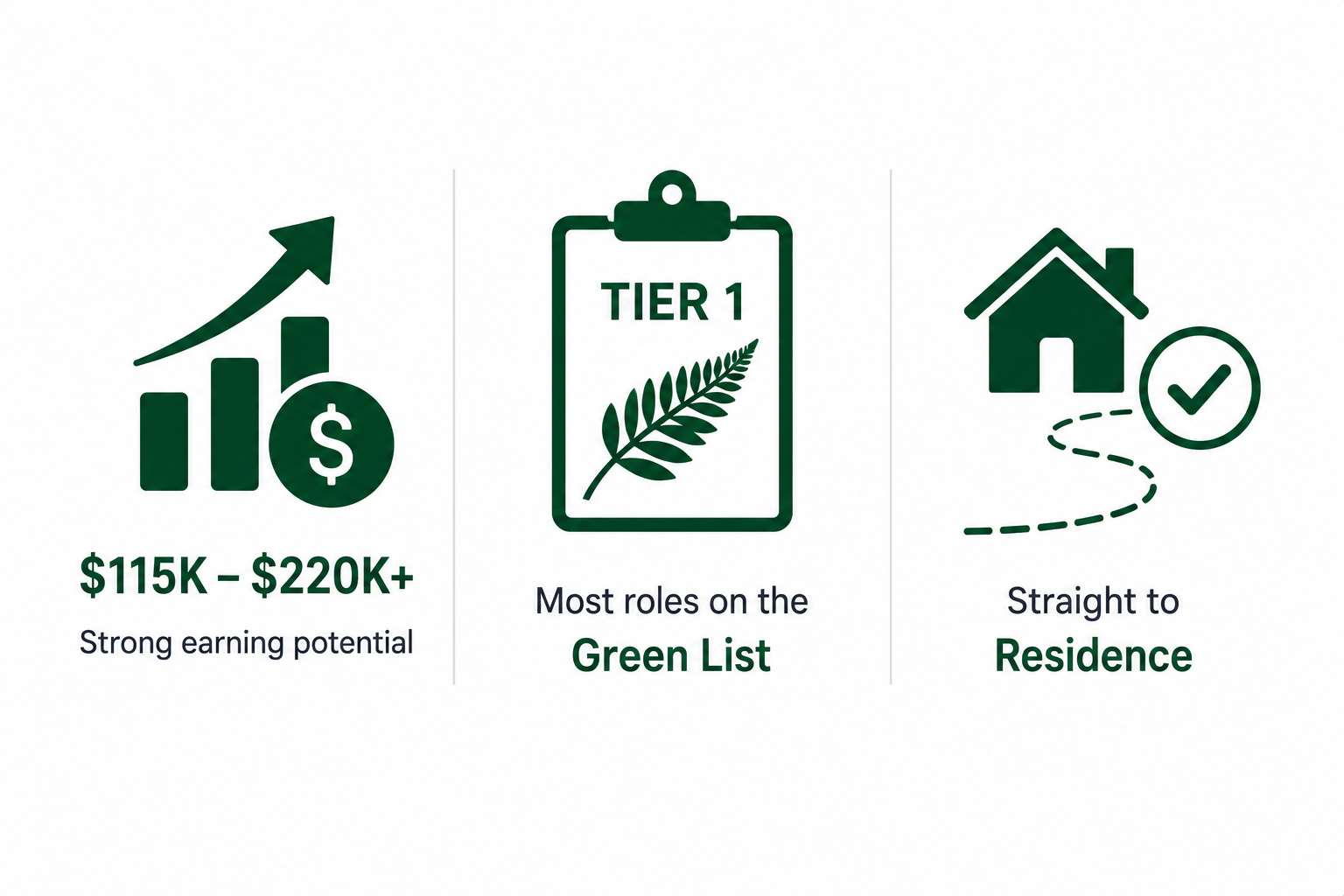
The median full-time software engineer in New Zealand earns approximately NZD $115,000 per year. Senior engineers in Auckland or Wellington at established firms typically earn NZD $140,000 to $170,000. Specialist roles (security, ML, principal engineering) reach NZD $180,000 to $220,000. Most senior software engineering and ICT roles sit on Tier 1 of the New Zealand Green List, which means qualified candidates can apply for the Straight to Residence visa: a direct path to permanent residence.
IT salary by role
The biggest pay gaps in New Zealand tech come from role specialisation, not seniority alone. A senior security engineer outpaces a senior backend engineer by 15 to 25 percent at the same experience level.
| Role | Median | Range | Demand | Green List |
|---|---|---|---|---|
| Software Engineer (Backend) | $120,000 | $105,000 - $140,000 | High (steady) | Tier 1 (Software Engineer) |
| Software Engineer (Frontend) | $115,000 | $100,000 - $135,000 | High | Tier 1 |
| Full-Stack Engineer | $120,000 | $105,000 - $140,000 | High | Tier 1 |
| Mobile Engineer (iOS / Android) | $120,000 | $105,000 - $140,000 | Moderate | Tier 1 |
| DevOps / SRE Engineer | $135,000 | $120,000 - $160,000 | Acute shortage | Tier 1 (ICT Systems / Network Engineer) |
| Cloud Architect | $150,000 | $135,000 - $180,000 | Acute shortage | Tier 1 |
| Data Engineer | $130,000 | $115,000 - $155,000 | High | Tier 1 |
| Data Scientist / ML Engineer | $135,000 | $115,000 - $165,000 | High at senior level | Tier 1 |
| Security Engineer | $145,000 | $125,000 - $180,000 | Acute shortage | Tier 1 |
| QA / Test Engineer | $95,000 | $85,000 - $115,000 | Moderate | Tier 2 (some senior roles) |
| Engineering Manager (small team) | $150,000 | $135,000 - $175,000 | Steady | Varies by underlying role |
| IT Project Manager | $130,000 | $115,000 - $150,000 | Steady | Tier 1 (ICT Project Manager) |
| Business / Systems Analyst | $110,000 | $95,000 - $130,000 | Moderate | Tier 2 |
| UX / Product Designer | $115,000 | $100,000 - $135,000 | Moderate | Not listed (AEWV pathway) |
| Product Manager (Software) | $135,000 | $120,000 - $160,000 | Moderate-high | Not listed (AEWV pathway) |
Some context on what is and is not in the table:
- Mobile (iOS / Android) sits between frontend and backend; pay is similar to backend.
- Site Reliability Engineering (SRE) sits with DevOps for compensation purposes.
- Engineering Manager pay is comparable to senior engineer in NZ; the IC vs manager pay gap is much smaller than in the US.
- Founders, technical CEOs, and CTO of established startups are off-table; comp depends on equity.
IT salary by experience level
New Zealand has a relatively flat seniority curve compared to the US. The jump from Senior to Principal is meaningful but not as dramatic.
| Level | Range | Title | Scope |
|---|---|---|---|
| Graduate (0-1 yr) | $65,000 - $85,000 | Junior / Associate Engineer | Scale-ups, big banks graduate programmes |
| Junior (1-3 yrs) | $85,000 - $110,000 | Software Engineer | Owns small features, contributes to a single service |
| Mid-level (3-6 yrs) | $105,000 - $135,000 | Software Engineer / Senior in some companies | Owns a service end-to-end, mentors juniors |
| Senior (6-10 yrs) | $130,000 - $170,000 | Senior Software Engineer | Leads a small team or owns a complex system |
| Staff (10+ yrs) | $160,000 - $200,000 | Staff / Lead Engineer | Cross-team technical leadership |
| Principal (12+ yrs) | $180,000 - $230,000+ | Principal / Distinguished Engineer | Org-wide technical authority; rare in NZ outside large banks and listed firms |
What "Senior" means in NZ tech:
- 6+ years of relevant experience
- Lead a small team (2-4 engineers) or own a system end-to-end
- Trusted to make architectural decisions without supervision
Most established New Zealand tech employers (Xero, Trade Me, Datacom, Mantel Group, Pushpay, ANZ NZ, BNZ) advertise Senior roles starting at NZD $130,000 to $140,000 and topping out around NZD $170,000.
IT salary by city
Auckland and Wellington are the two main tech cities. Christchurch has a smaller but real tech cluster across listed firms, gov-tech contractors and product startups. Most non-frontline tech roles can be done remotely from anywhere in New Zealand if the employer is set up for it; salary in remote roles tends to follow Auckland or Wellington bands rather than dropping to the smaller-city average.
| City | Median | Range | Tech employer count | Cost-of-living index |
|---|---|---|---|---|
| Auckland | $125,000 | $110,000 - $145,000 | Largest in NZ | 100 (baseline) |
| Wellington | $120,000 | $105,000 - $140,000 | 2nd largest, gov-tech heavy | ~88 |
| Christchurch | $110,000 | $100,000 - $130,000 | Small but real cluster | ~78 |
| Hamilton / Tauranga / other | $100,000 | $90,000 - $115,000 | Limited; often remote roles | ~75-80 |
Remote work note: post-2022, most major NZ tech employers offer hybrid (2-3 days office) by default. Fully remote roles exist but are concentrated in startups and at engineering specialist levels (senior/staff/principal). Junior fully-remote roles are uncommon.
Top New Zealand tech employers and what they pay
Where you work matters as much as your role and seniority. The salary spread between a top-tier employer and a mid-tier one for the same role is typically 15 to 25 percent.
| Tier | Examples | Senior SWE base | Equity | AEWV-accredited |
|---|---|---|---|---|
| Tier 1: Listed NZ tech / global tech NZ offices | Xero, Pushpay, Datacom, Atlassian (NZ presence), Canva (NZ remote) | $150,000 - $180,000 | Meaningful (RSU or options, varies) | Yes |
| Tier 2: Major banks and finance | ANZ NZ, BNZ, ASB, Westpac, Kiwibank | $140,000 - $170,000 | Limited; bonus 10-20% common | Yes |
| Tier 3: Big consultancies | Deloitte, PwC, EY, KPMG, Accenture NZ | $130,000 - $165,000 | None (partner-track only) | Yes |
| Tier 4: Government tech | IRD, MBIE, ACC, NZTA, Ministry of Health | $125,000 - $150,000 | None; secure tenure, work-life balance | Yes |
| Tier 5: Funded NZ scale-ups (Series B+) | Halter, Sharesies, Hnry, Auror, MyTutor (NZ team) | $130,000 - $160,000 | Meaningful (options grants) | Most are |
| Tier 6: Early-stage startups (Seed / Series A) | (varies) | $115,000 - $140,000 | Substantial (1-2% for early hires not uncommon) | 50/50; ask before applying |
Caveats: ranges are observed offers in the last 12 months from publicly available leveling data, not official figures from the companies. Equity (RSU or option grants) can add 10-30 percent on top at the listed scale-ups, but is generally less generous than at US peers.
How tech salaries map to Green List residency
Several core software and ICT roles are on Tier 1 of the New Zealand Green List, which means qualified candidates can apply for the Straight to Residence visa: direct permanent residence, no two-step pathway.
| Tier 1 - Straight to Residence | Tier 2 - Work to Residence (24 months) |
|---|---|
|
|
Always confirm the current Green List at immigration.govt.nz before lodging an application: the list is reviewed approximately every 12 months.
Roles often misclassified as "not on the Green List" (it depends on the actual ANZSCO mapping)
The Green List is keyed to ANZSCO occupation codes and the duties listed in your job description, NOT your job title at one specific employer. A "Product Manager" role can map to a Green List ANZSCO code if the actual day-to-day duties are predominantly engineering or systems-analyst work; a "Software Engineer" role can fall outside Tier 1 if the duties are mostly support and configuration. Check the ANZSCO mapping with a licensed adviser before assuming.
Roles that often DO need careful mapping (and may end up off Tier 1):
- UX / Product Designer
- Product Manager (Software)
- Engineering Manager (some scopes)
- Pure data analyst (non-engineering)
Two important fallbacks if your role is genuinely off the Green List:
- Tier 1 also has occupation-specific pay thresholds in addition to the ANZSCO match. If your offer is below the Tier 1 threshold for your occupation, you cannot use Straight to Residence, even if the ANZSCO code matches.
- The Skilled Migrant Category 6-point residence pathway is the standard fallback. SMC awards points for skilled employment, qualifications, registration, and income, with a 6-point pass mark since the 2023 reset. Many tech roles that miss Tier 1 still pass SMC comfortably.
To use the Tier 1 Straight to Residence pathway as a software professional, you typically need:
- A job offer from a New Zealand employer matching the listed occupation
- Bachelor degree or higher in IT, computer science, software engineering, or a related field (or recognised equivalent professional experience: 7+ years for some occupations)
- Pay at or above the applicable wage threshold. The immigration median wage was updated to NZD $35.00 per hour from 9 March 2026 (Stats NZ June 2025 data). For most ICT Green List occupations this is well below senior tech salaries; some occupations have higher specific thresholds.
- Approval as a New Zealand Resident under the Straight to Residence category
For tech professionals who do not yet have a job offer, the Accredited Employer Work Visa (AEWV) is the standard entry route. Most large NZ tech employers and many mid-sized ones are accredited.
Visa-friendly hiring in NZ tech: employer accreditation matters
Roughly 80-85 percent of mid- and large-sized NZ tech employers are AEWV-accredited as of early 2026, including:
- All major banks (ANZ, BNZ, ASB, Westpac, Kiwibank)
- All listed NZ tech companies (Xero, Pushpay, Datacom, EROAD)
- Major consultancies (Deloitte, PwC, EY, KPMG, Accenture NZ)
- Most government departments hiring tech (IRD, MBIE, ACC, NZTA)
- Most Auckland and Wellington scale-ups with 50+ headcount
If you are talking to a smaller startup or a hiring manager who has not sponsored a visa before, ask the question early. Sponsoring a non-accredited employer takes 6-10 weeks of additional process for them, which often kills the offer for budget reasons. Accredited employers can move from offer to AEWV grant in 4-8 weeks.
Tax and take-home pay for tech salaries
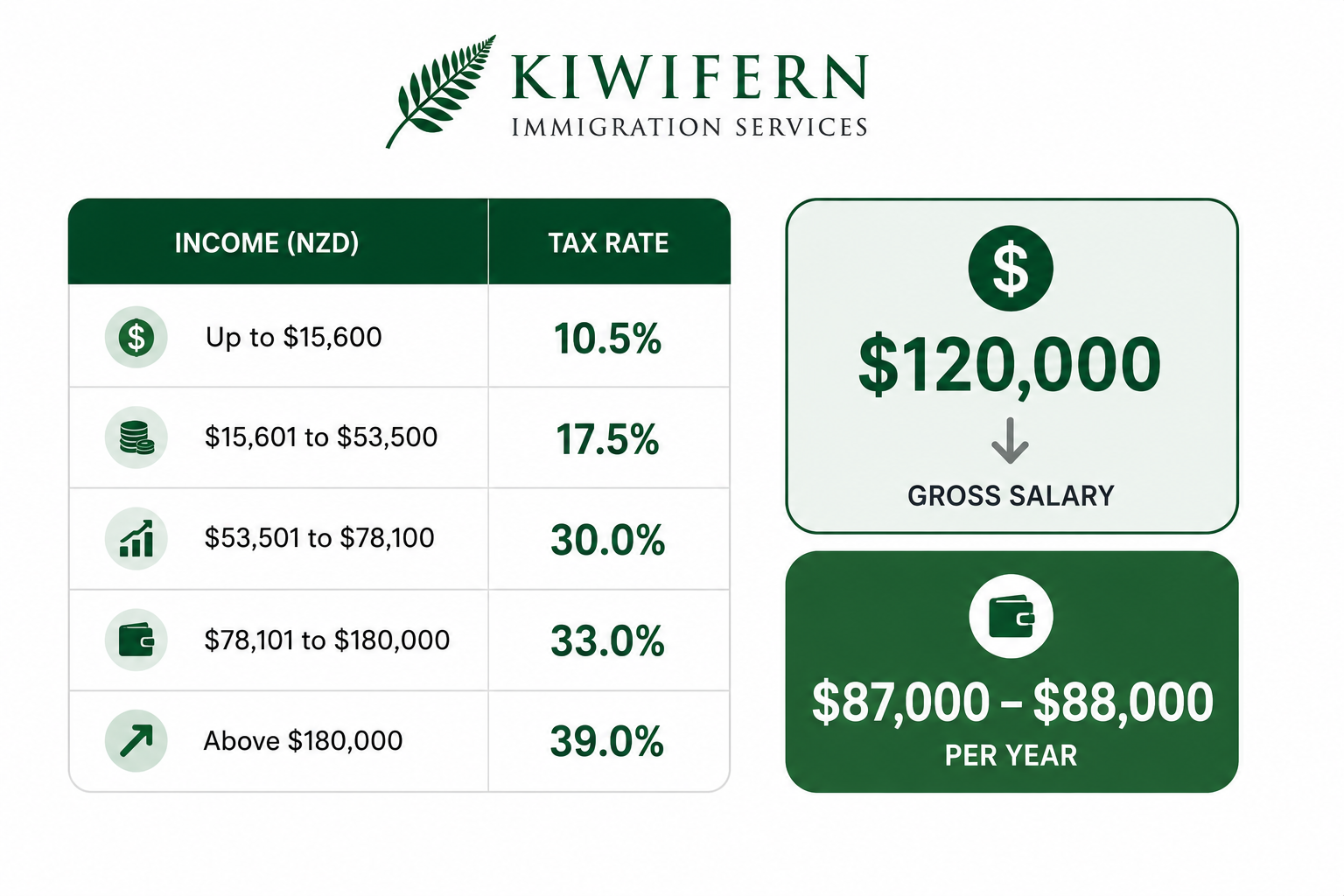
NZ income tax is progressive:
| Income | Rate |
|---|---|
| Up to NZD $15,600 | 10.5% |
| NZD $15,601 to $53,500 | 17.5% |
| NZD $53,501 to $78,100 | 30.0% |
| NZD $78,101 to $180,000 | 33.0% |
| Above NZD $180,000 | 39.0% |
Plus ACC earner levy (FY 2025-26 maximum liable earnings was $142,283; FY 2026-27 cap is $152,790 per MBIE). Plus KiwiSaver (optional; default 3% employee with 3% employer minimum match). Tax rates and ACC levies change. Confirm current figures with ird.govt.nz and acc.co.nz before relying on a take-home estimate.
A NZD $150,000 senior engineer takes home roughly NZD $107,000 to $108,000 after tax and ACC, before KiwiSaver, on the rates above. Use the official PAYE calculator at ird.govt.nz/tools-and-calculators for your specific situation.
Frequently asked questions
Is New Zealand a good country for software engineers?
Yes for most engineers, especially those prioritising lifestyle, family time, and a clear residency pathway. Pay is lower than the US and slightly lower than Australia, but cost of living outside Auckland is moderate, work-life balance is genuinely respected at most employers, and the Green List makes residence faster than for most other tech destinations.
Can I get a tech job in New Zealand from overseas?
Yes, especially at senior level. Most major NZ tech employers (Xero, Datacom, the big banks, government tech) are AEWV-accredited and routinely hire from overseas for senior, staff, and specialist roles. Junior remote-first hires from outside NZ are rarer.
What is the highest-paying tech role in New Zealand?
Principal Security Engineers and Principal Site Reliability Engineers at major banks and listed tech firms are typically the top paid in salaried roles, regularly NZD $200,000 to $240,000 base plus bonuses. Specialist consulting (cloud architecture, security advisory) at Big Four firms also reaches similar territory at the partner-track level.
Do I need a degree to work in tech in New Zealand?
Not strictly for many roles. Senior software engineers and SREs without formal CS degrees are common, especially with strong portfolios or industry certifications. For visa purposes via the Straight to Residence pathway, the relevant Green List occupation may require a bachelor's degree OR 7+ years of recognised professional experience as an alternative; check the specific occupation listing.
How does NZ tech pay compare to Australia?
Australian tech salaries are 20 to 30 percent higher at most levels, especially at senior and staff. Sydney and Melbourne also have larger and more diverse tech markets. Many NZ-trained engineers move to Australia at staff level for the salary uplift; some return for family or lifestyle reasons. We help clients work through this trans-Tasman question; see our Australia services page.
What are the typical interview rounds at NZ tech employers?
Most established employers run a 3-4 round process: recruiter screen, hiring manager call, technical screen (often a 60-90 minute coding session), and an onsite or virtual loop with 2-3 engineers and a manager. Take-home assignments still exist but are less common than 5 years ago. Total elapsed time from first contact to offer is typically 3-5 weeks for senior roles.
Are remote-only tech jobs available in New Zealand?
Yes but they are concentrated at senior and specialist levels. Most NZ tech employers default to hybrid (2-3 days office). Fully-remote opportunities exist for senior engineers, SREs, and security specialists. Junior fully-remote hiring inside NZ is uncommon.
Is the New Zealand tech industry in shortage right now?
Yes for senior and specialist roles. Software engineers, SREs, security engineers, and data engineers are all on the Green List Tier 1 or Tier 2. The market for junior-only candidates is more competitive; new graduates and 1-2 year engineers face a smaller employer pool.
How do I find a tech job in New Zealand from overseas?
Apply directly through company careers pages (Xero, Datacom, the major banks publish openings on their own sites and on Seek NZ). LinkedIn is widely used for inbound recruiter outreach at senior levels. Specialist recruiters in NZ tech: Talent NZ, Robert Walters, Hays, and Absolute IT. Most established firms run remote interview loops for international candidates.
Talk to Kiwi Fern about your tech migration
If you work in software, data, or IT and want a candid read on your residency pathway, salary expectations, and timeline, we can help. Our team has 20+ years of experience with skilled migration and works with tech professionals into New Zealand every month.