

NZ Immigration Update 1 June 2026: AEWV English Extended and Active Investor Plus Philanthropy
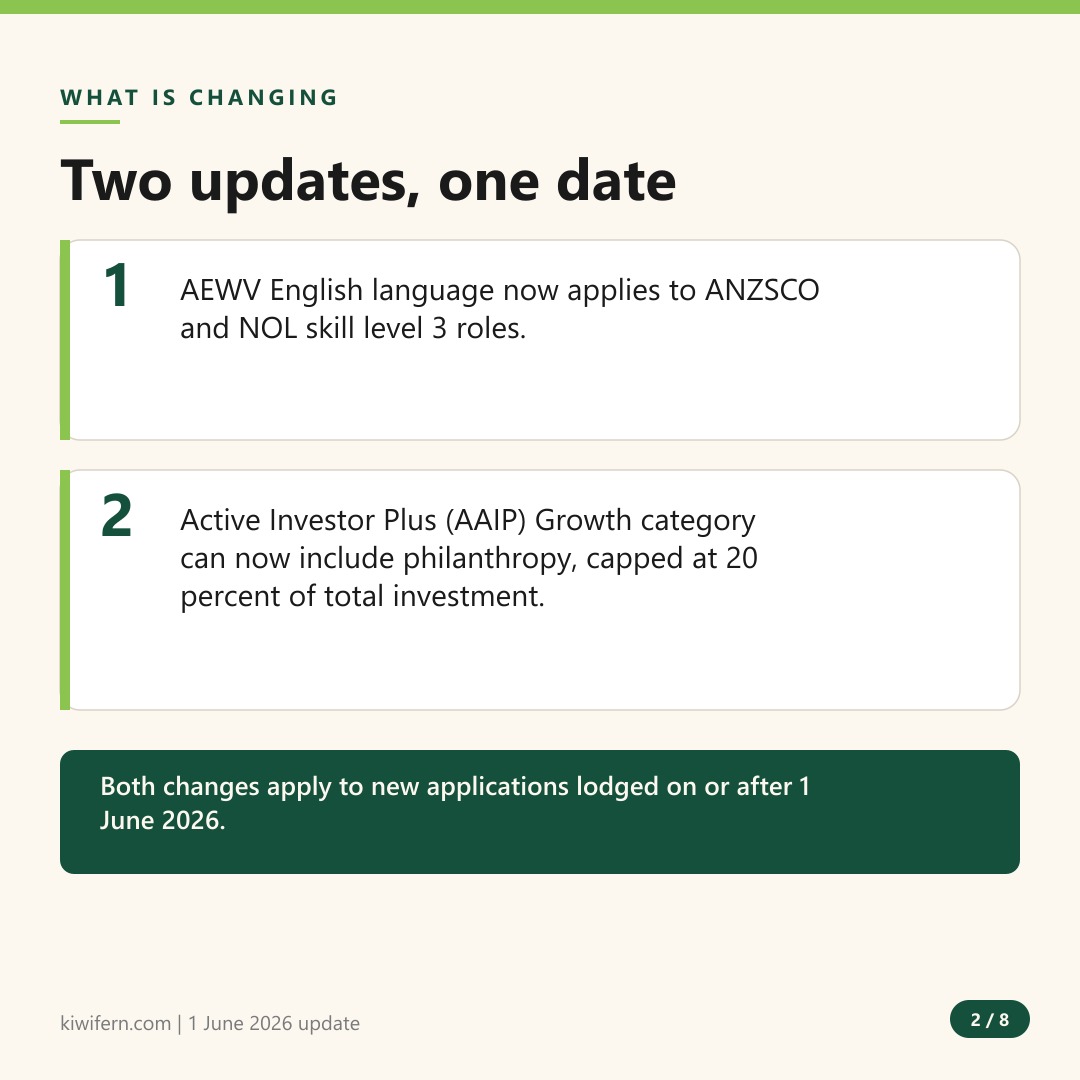
Two New Zealand immigration changes take effect on 1 June 2026. AEWV English language requirements now extend to ANZSCO and NOL skill level 3 roles. The Active Investor Plus (AAIP) Growth category now allows philanthropy as part of the investment portfolio, capped at 20 percent of total investment.
Quick summary
On 25 May 2026 Immigration New Zealand announced two policy changes that both take effect on 1 June 2026:
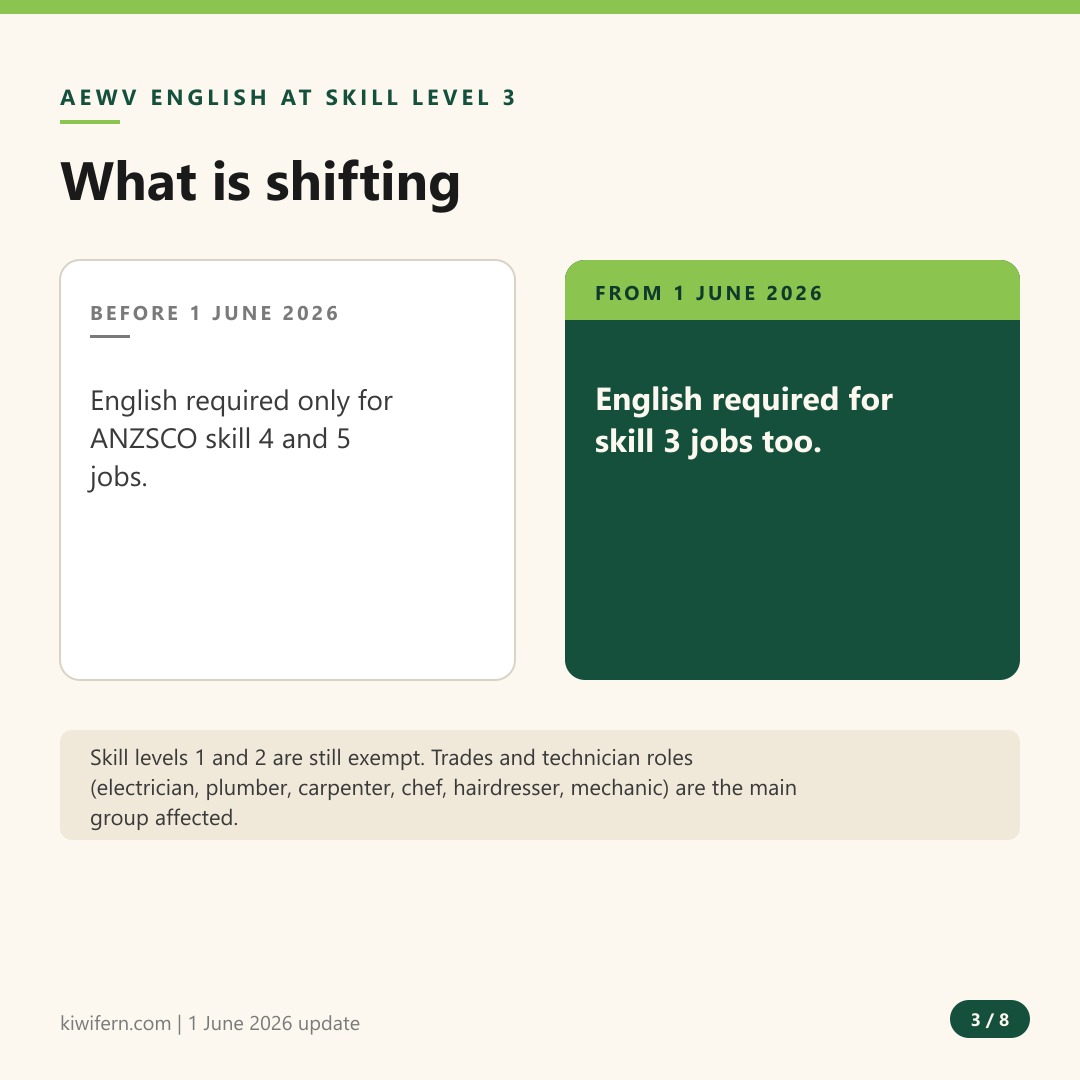
- Accredited Employer Work Visa (AEWV) English language requirements now extend to ANZSCO and NOL skill level 3 roles. Until now, AEWV applicants only had to prove English for skill level 4 and 5 jobs. From 1 June 2026, skill 3 applicants also need to meet a minimum English test score or qualify through an English-speaking background.
- The Active Investor Plus (AAIP) Visa Growth category now allows philanthropy as part of the investment portfolio, capped at 20 percent of the total investment. For an NZD 5 million Growth applicant that is up to NZD 1 million directed to eligible charities or conservation projects.
Both changes apply to new applications lodged on or after 1 June 2026. The AEWV change has clear transition rules for current visa holders. The AAIP change applies only to the Growth category, not the Balanced category.
Immigration rules change often. Always confirm the latest detail on immigration.govt.nz before you apply. This guide is informational, not legal advice.

Why these changes matter
The two changes target different ends of the immigration market, but they share a theme: New Zealand is tightening some settings while loosening others to make the country more attractive on its own terms.
- AEWV English at skill 3 signals that Government wants AEWV workers in mid-skilled roles to integrate well with co-workers, customers, and the wider community. It also brings the AEWV rules closer to the standards used in skilled residence pathways.
- AAIP philanthropy signals that Government wants the Active Investor Plus Visa to deliver more than just capital flowing into managed funds. Growth investors can now direct a meaningful portion of their NZD 5 million plus into causes that benefit New Zealand directly.
If you are mid application or planning one this winter, the date to put on your calendar is 1 June 2026.
Effective date and timeline
| Date | What happened or happens |
|---|---|
| 7 April 2024 | English language requirement introduced for AEWV ANZSCO skill 4 and 5 roles |
| 1 April 2025 | Major AAIP reset, Growth (NZD 5M, 3 years) and Balanced (NZD 10M, 5 years) categories created |
| 25 May 2026 | Immigration NZ announces both 1 June 2026 changes |
| 1 June 2026 | AEWV English at skill 3 takes effect, AAIP Growth philanthropy takes effect |
| 1 December 2026 | Cut off for the AEWV "current visa expiring soon" transition rule |
Sources: Immigration New Zealand, English language requirements extended to AEWV skill level 3 roles (25 May 2026) and Active Investor Plus change enables philanthropy in Growth category (25 May 2026).
Part 1: AEWV English language now applies to skill level 3 roles
What is changing
Until 1 June 2026, AEWV applicants only had to prove English when the job was at ANZSCO or NOL skill level 4 or 5. ANZSCO 1 to 3 jobs (most professional, technical and skilled trades roles) did not have an English test requirement.
From 1 June 2026 onwards, the requirement extends to skill level 3. That means a much larger group of AEWV applicants will need to provide test results or qualify through an English-speaking background when they lodge their first AEWV in a skill 3 role.
ANZSCO and NOL skill levels 1 and 2 remain exempt. The change is targeted at skill 3 only.
Who is affected
The change applies if all three of the following are true:
- You are applying for a new AEWV (not extending an existing one in the same role), AND
- Your job is at ANZSCO or NOL skill level 3, AND
- You do not fall into one of the exempt categories below.
Examples of common ANZSCO skill level 3 roles include trades and technician occupations: carpenter, electrician, plumber, motor mechanic, chef, hairdresser, dental technician, early childhood educator and many engineering technician roles. The skill level for each ANZSCO code is published on the official ANZSCO classification.
If you are unsure where your job sits, check with your employer or use the ANZSCO search on the Immigration NZ AEWV job check page.
Exemptions and transition rules
Not every skill 3 AEWV applicant will be hit by the new rule. Immigration NZ has confirmed the following exemptions and transitional cases:
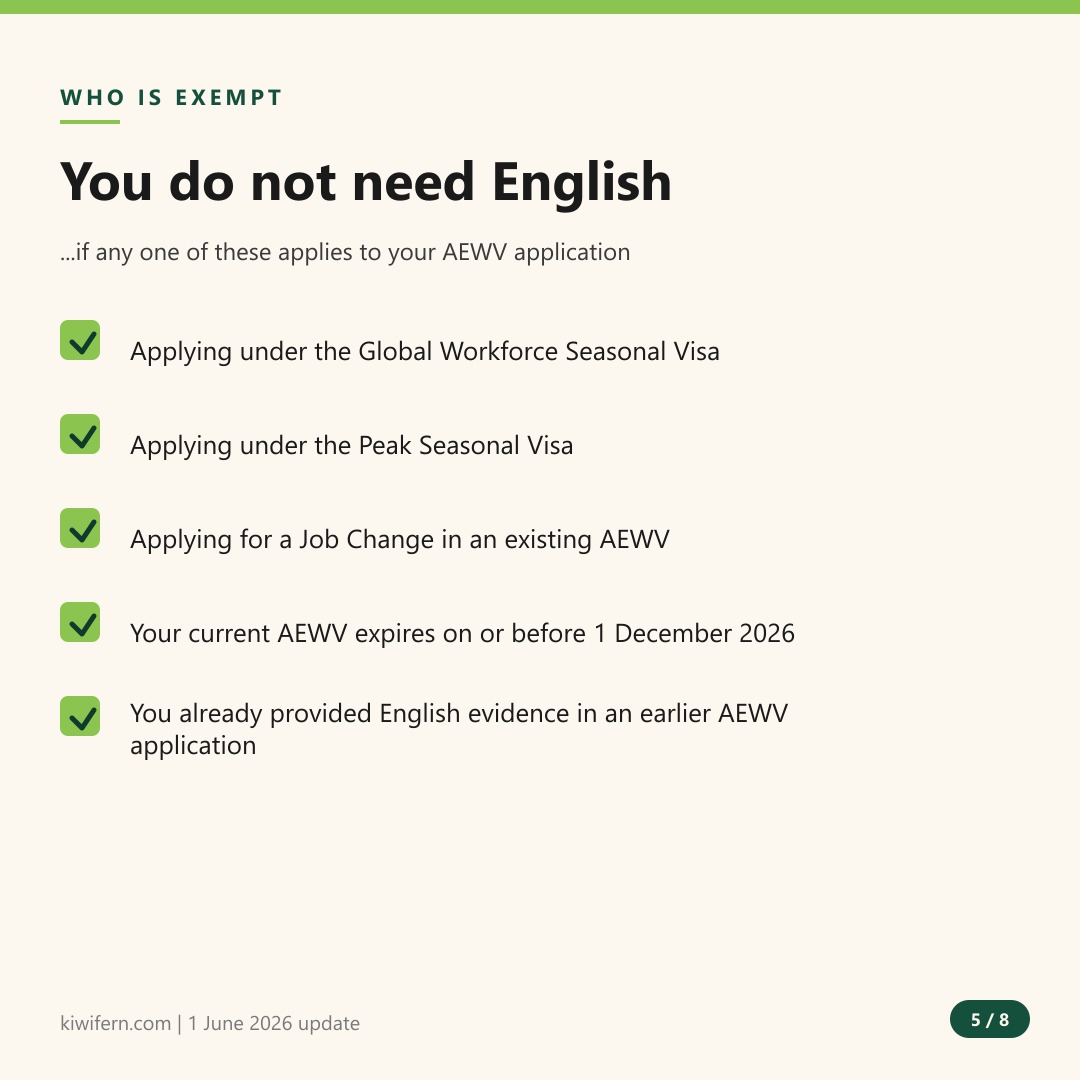
- Global Workforce Seasonal Visa applications are exempt.
- Peak Seasonal Visa applications are exempt.
- Job Change applications (existing AEWV holders changing employer or role) are exempt.
- Applicants with a current AEWV expiring on or before 1 December 2026 are exempt when applying for a further AEWV in a skill 3 role. This is the practical transition rule for people already in New Zealand on a current AEWV that runs out within 6 months of the change.
- Applicants who already provided English language evidence in an earlier AEWV application are exempt from re-providing it.
If you are mid renewal, you should check your AEWV expiry date against 1 December 2026 first. That single date determines whether the new English rule applies to your next application.
Accepted English tests and minimum scores
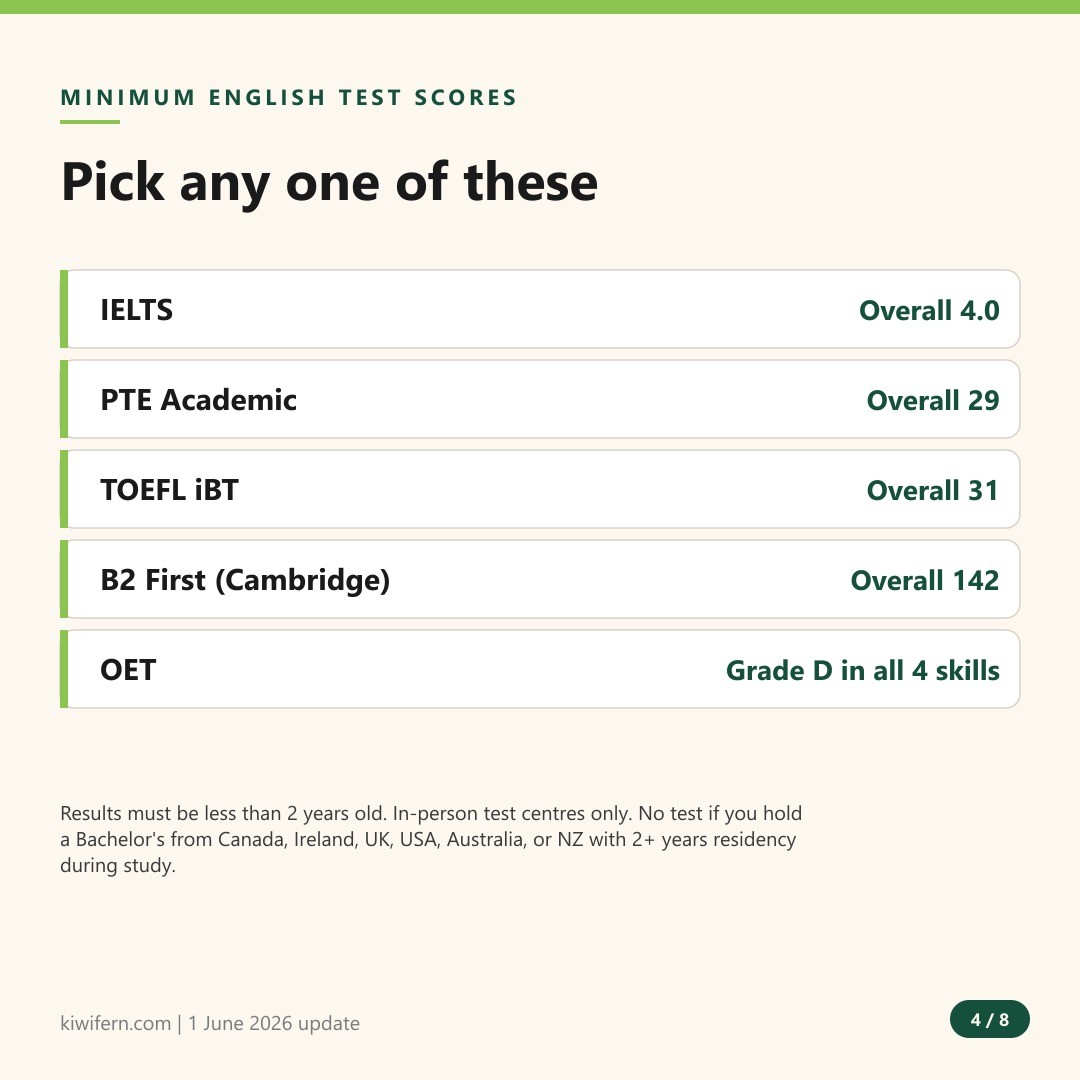
The AEWV English standard is the same one already used for skill 4 and 5 roles. Test results must be no more than 2 years old at the date you apply, and must be from an in-person test centre (remote tests are not accepted).
| Test | Minimum score |
|---|---|
| IELTS (General or Academic) | Overall 4.0 |
| TOEFL iBT | Overall 31 |
| PTE Academic | Overall 29 |
| B2 First (Cambridge) | Overall 142 |
| B2 First for Schools | Overall 142 |
| OET | Grade D or higher in all 4 skills |
This is a basic functional English level. It is lower than the standard required for skilled residence visas, where you typically need IELTS 6.5 or equivalent.
Meeting the requirement without a test
You can also meet the English requirement through an English-speaking background, which removes the need for a recent test. Immigration NZ accepts one of the following:
- Citizenship of a recognised English-speaking country plus 5 or more years of study or work in Canada, Ireland, the United Kingdom, the United States, Australia, or New Zealand.
- A Bachelor's degree (NZ Level 7 equivalent) completed at an institution in one of those countries, with at least 2 years of residency in that country during the study period.
- A postgraduate qualification (NZ Level 8 or higher) from one of those countries, with at least 1 year of residency in that country during the study period.
For Indian applicants, the most common workable route is sitting IELTS at a recognised IDP or British Council centre. Most professional and trades-trained candidates clear IELTS 4.0 overall comfortably with light preparation.
What AEWV applicants should do now
If you are about to apply for an AEWV in an ANZSCO skill 3 role on or after 1 June 2026, work this checklist before lodging:
- Confirm your role is skill 3. Use the ANZSCO classification or ask Immigration NZ before paying for tests you do not need.
- Check the exemptions. If you fall under Global Workforce Seasonal, Peak Seasonal, Job Change, or have a current AEWV expiring on or before 1 December 2026, you do not need a fresh English test.
- Pick your test. IELTS is by far the most common in India, but PTE Academic and TOEFL iBT are also accepted and sometimes have shorter waiting times.
- Book a test centre slot now. With many skill 3 trades applying from June onwards, popular centres in major Indian and Philippine cities are likely to fill 4 to 6 weeks ahead.
- Keep originals and digital copies. Immigration NZ wants the original Test Report Form or a verifiable online verification code that they can check themselves.
What employers and accredited employers should do
If you are an accredited employer recruiting overseas workers into a skill 3 role, the change adds one step to your candidate pre screen:
- Update your overseas recruitment template to ask candidates for current English test results or evidence of an English-speaking background.
- For candidates not yet tested, share the Immigration NZ AEWV English page so they understand what is acceptable.
- Plan a 6 to 10 week buffer between job offer and AEWV lodgement to accommodate testing.
This is a small change to your recruitment SOP, but the cost of skipping it is high. An incomplete application without English evidence may be declined under section 16 of the Immigration Act 2009 for failure to meet visa requirements.
Part 2: Active Investor Plus Growth category now allows philanthropy
What is changing
The Active Investor Plus (AAIP) Visa was rebuilt in April 2025 with two categories:
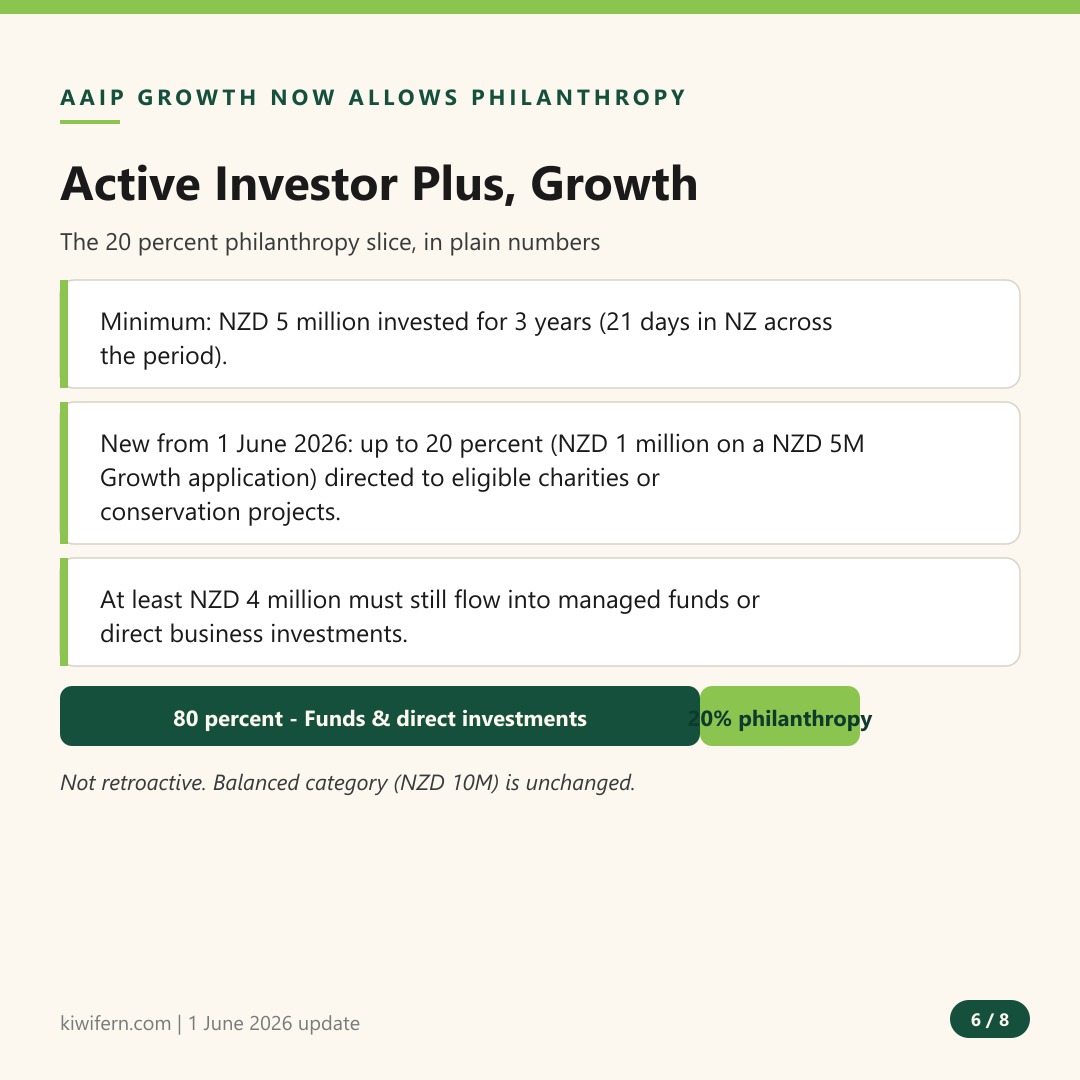
- Growth category: NZD 5 million minimum, invested for at least 3 years (36 months), with 21 days in New Zealand across the holding period. Higher risk asset classes: managed funds and direct investments into NZ businesses.
- Balanced category: NZD 10 million minimum, invested for at least 5 years (60 months), with 105 days in New Zealand. Wider asset choice: managed funds, direct investments, listed equities, philanthropy, bonds and property developments.
Until 1 June 2026, philanthropy was an acceptable investment under the Balanced category only. Growth applicants had to direct all NZD 5 million into managed funds or direct business investments.
From 1 June 2026, new Growth category applicants can include philanthropy capped at 20 percent of their total investment. For an NZD 5 million Growth applicant, that allows up to NZD 1 million directed to charities or conservation projects, with the remaining NZD 4 million sitting in managed funds or direct investments.
Immigration NZ has been clear that the cap is firm. You cannot weight a Growth application heavily towards philanthropy. The bulk of the capital must still flow into the riskier productive asset classes the Growth category was designed for.
Eligible philanthropy
Two broad categories qualify:
- Charities registered in New Zealand (typically those listed on the Charities Services register).
- Conservation projects in New Zealand, such as predator control, habitat restoration, and protected area work.
Immigration NZ has confirmed that safeguards apply: the philanthropy must be a genuine donation that does not personally benefit you or your family. Giving to an entity you control, or that pays you back in services or shares, will not qualify.
The full list of eligible philanthropic vehicles and how Immigration NZ will verify them is expected to sit on the Acceptable investments for an Active Investor Plus Visa page from 1 June 2026.
What is not changing
A handful of important things about the AAIP are not affected by this update:
- The Balanced category remains at NZD 10 million with the same asset choices and the same 5 year holding period. Philanthropy was already eligible there.
- The Growth category minimum stays at NZD 5 million with a 3 year holding period.
- Time in New Zealand minimums are unchanged: 21 days for Growth, 105 days for Balanced (reducible if you also put capital into the Growth category).
- No English language requirement applies to either AAIP category.
- The application fee is unchanged at around NZD 27,470, and Immigration NZ continues to publish a target of 80 percent of approvals in principle within 3.5 months.
Who this matters to
The AAIP audience is small in absolute numbers but high in capital: family offices and high net worth individuals looking at New Zealand residence with a 3 to 5 year horizon. The philanthropy expansion makes the Growth category materially more attractive in three ways:
- Reputational alignment. Migrants who care about doing good in New Zealand can now direct a slice of the required investment to projects they care about, rather than treating the visa as a pure financial transaction.
- Risk balance. Philanthropy is a "spent" outflow rather than a market exposure. For a Growth applicant who wants part of the capital removed from market risk, philanthropy now offers a route to do that inside the 20 percent cap.
- Family conversation. For a family deciding between Growth (3 years, NZD 5M) and Balanced (5 years, NZD 10M), the ability to donate NZD 1 million within the Growth route is a meaningful sweetener.
For most of Kiwi Fern's client base (students and skilled workers from India, Southeast Asia and the Pacific looking at residence through work or study), the AAIP is not the right product. The investor route is one to flag, not one to push.
What prospective AAIP applicants should do now
If you or your adviser is preparing an AAIP Growth application:
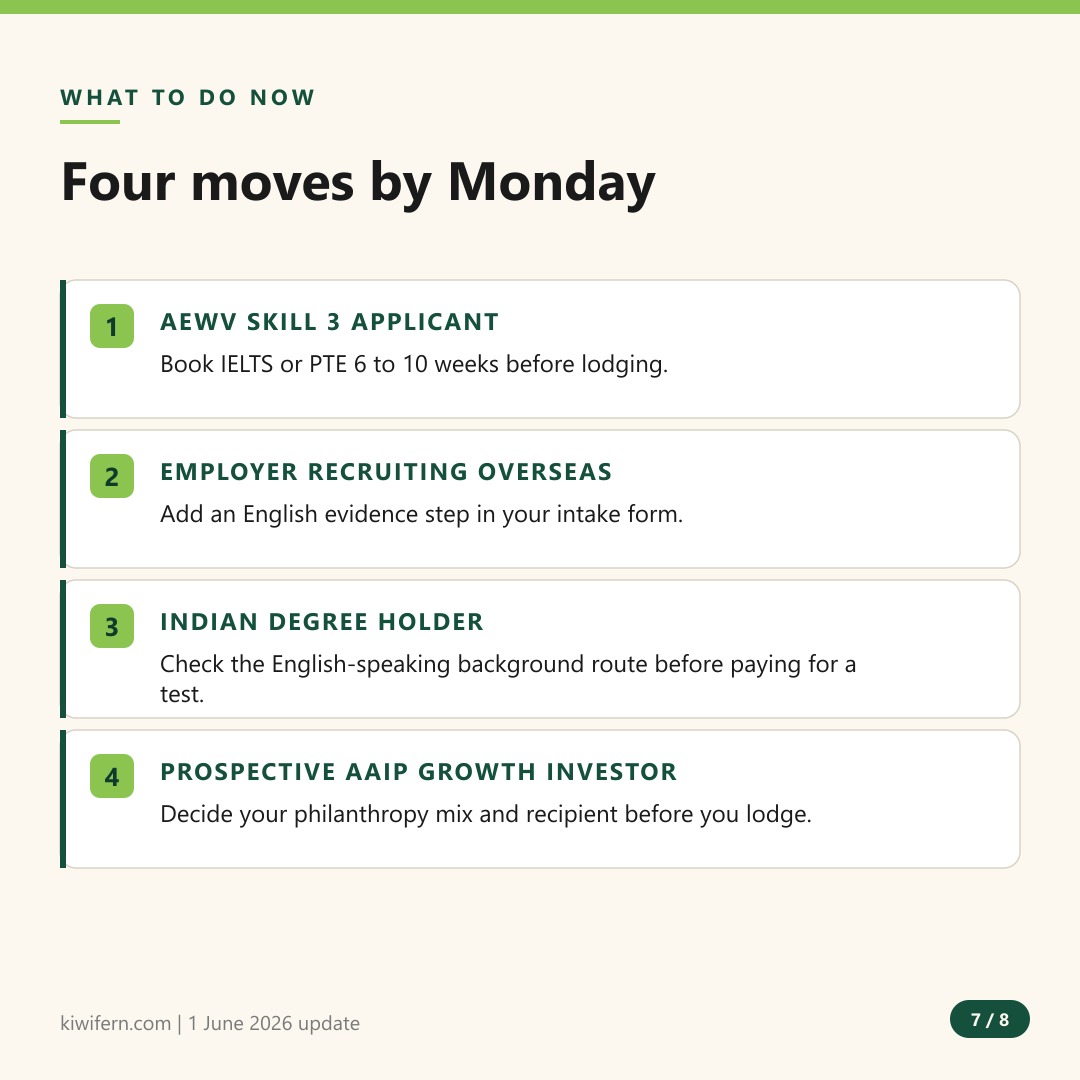
- Decide the philanthropy mix before you lodge. Once you have committed to a category and a portfolio shape, it is harder to change.
- Confirm the philanthropy recipient is on Immigration NZ's eligible list when the official list is published from 1 June 2026.
- Document the donation flow. As with any AAIP investment, you will need clear evidence of the funds leaving you and arriving at the recipient, free of any reciprocal benefit.
- Plan around the 21 day NZ presence rule. Philanthropic engagement often involves a site visit, which can sit alongside your 21 day Growth presence requirement.
- Work with a qualified adviser. AAIP applications are evidence heavy, and even a small documentation gap can delay the approval in principle.
What this means for the existing AEWV cluster
If you are inside Kiwi Fern's main target audience (skilled workers and students looking at New Zealand for work and residence), the AEWV English change is the headline.
A few practical points by persona:
- Skilled trades worker on an ANZSCO 3 role (electrician, plumber, carpenter, mechanic, chef). Plan an IELTS or PTE booking 6 to 10 weeks ahead of your AEWV lodgement. A 4.0 overall IELTS is achievable for most trades trained candidates with structured practice.
- Healthcare assistant or care worker on a NOL or ANZSCO 3 designation. Your role likely now needs English evidence. Many care employers prefer OET because the format reflects on the job communication, and Immigration NZ accepts OET grade D in all 4 skills.
- Indian student finishing study in New Zealand and moving onto an AEWV in a skill 3 role. If you completed an NZ Level 7 (Bachelor's) or higher with 2 years' residency, you may already meet the English-speaking background route, no test needed.
- Existing AEWV holder in a skill 3 role. Check your expiry. If your visa expires on or before 1 December 2026, you keep your exemption for the next AEWV in the same skill level. If your visa expires later, plan an English test.
- Employer recruiting into a skill 3 role from overseas. Update your candidate intake form. Build in a 6 to 10 week English test buffer before lodging the AEWV.
We have practical guides that pair well with this update:
- How to Apply for the Accredited Employer Work Visa
- Green List Jobs in New Zealand
- New Zealand Work Visa pillar guide
FAQs
1. I am applying for an AEWV in a skill 3 role on 28 May 2026. Do I need to provide English evidence?
No. The new requirement starts for applications lodged on or after 1 June 2026. Applications lodged before that date are assessed under the previous settings. That said, if your application is still under review on 1 June 2026, Immigration NZ may or may not ask for additional evidence depending on processing stage. Get the test booked if you can.
2. What is the minimum IELTS score for the AEWV?
The AEWV English standard is IELTS 4.0 overall (General or Academic). The test must be no more than 2 years old at the date of application, and must be done at an approved test centre.
3. Does PTE Academic work for the AEWV?
Yes. PTE Academic at 29 overall meets the AEWV English standard. PTE is often easier to book in India than IELTS in May and June, so worth checking.
4. I am an Indian Bachelor's degree holder. Do I still need to sit IELTS?
Possibly not. If your Bachelor's was completed in Canada, Ireland, the UK, the US, Australia, or New Zealand with at least 2 years' residency during the study period, you meet the English-speaking background route and do not need a test. An Indian Bachelor's on its own does not qualify, even if the medium of instruction was English.
5. My ANZSCO code is level 2. Does the new rule affect me?
No. The new rule applies to skill level 3 only. Skill levels 1 and 2 are not affected and continue to have no AEWV English requirement.
6. I am on a current AEWV that expires in October 2026. Do I need English for my next AEWV?
No. Your current AEWV expires before 1 December 2026, so you are inside the transition window. Your next AEWV in the same skill 3 role is exempt from the new English requirement. If you also provided English evidence in an earlier AEWV, that evidence carries forward.
7. Can I include philanthropy in my Active Investor Plus Balanced category application?
Yes. Philanthropy has been acceptable in the Balanced category since April 2025. The 1 June 2026 change only opens it up to the Growth category, subject to the 20 percent cap.
8. How is the 20 percent philanthropy cap calculated for AAIP Growth?
The cap applies to total investment, not just the eligible asset portion. For an NZD 5 million Growth applicant, that is up to NZD 1 million directed to eligible philanthropy and at least NZD 4 million directed to managed funds or direct investments.
9. Are the AAIP changes retroactive for current AAIP visa holders?
No. The 1 June 2026 change applies to new applicants in the Growth category. Investors who already hold an AAIP visa continue under the rules that applied when their visa was granted.
10. Where do I find the official latest AAIP and AEWV rules?
Always confirm directly on Immigration NZ:
- Active Investor Plus Visa
- English language requirements for an AEWV
- Acceptable investments for an Active Investor Plus Visa
Talk to us
The 1 June 2026 changes are not the biggest immigration update of the year (that is still the 24 August 2026 Skilled Migrant Category rebuild), but they hit two very different audiences directly. If you are in the middle of an AEWV skill 3 application or weighing an Active Investor Plus route, contact Kiwi Fern Immigration Services. We have been doing this for 20+ years and we will give you a clear, honest read of your options.
Book a Paid Consultation