

2026 Changes to the Skilled Migrant Category Resident Visa
On 24 August 2026, Immigration New Zealand will be making changes to the points system for the Skilled Migrant Category Resident Visa (SMC). Immigration New Zealand will also be adding 2 new pathways to the SMC, and making changes to the SMC wage threshold (median wage) rules.
Immigration rules and wage rates change often. Always check immigration.govt.nz for the latest guidance before you apply. This article is general information, not immigration advice.
What is changing from August 2026
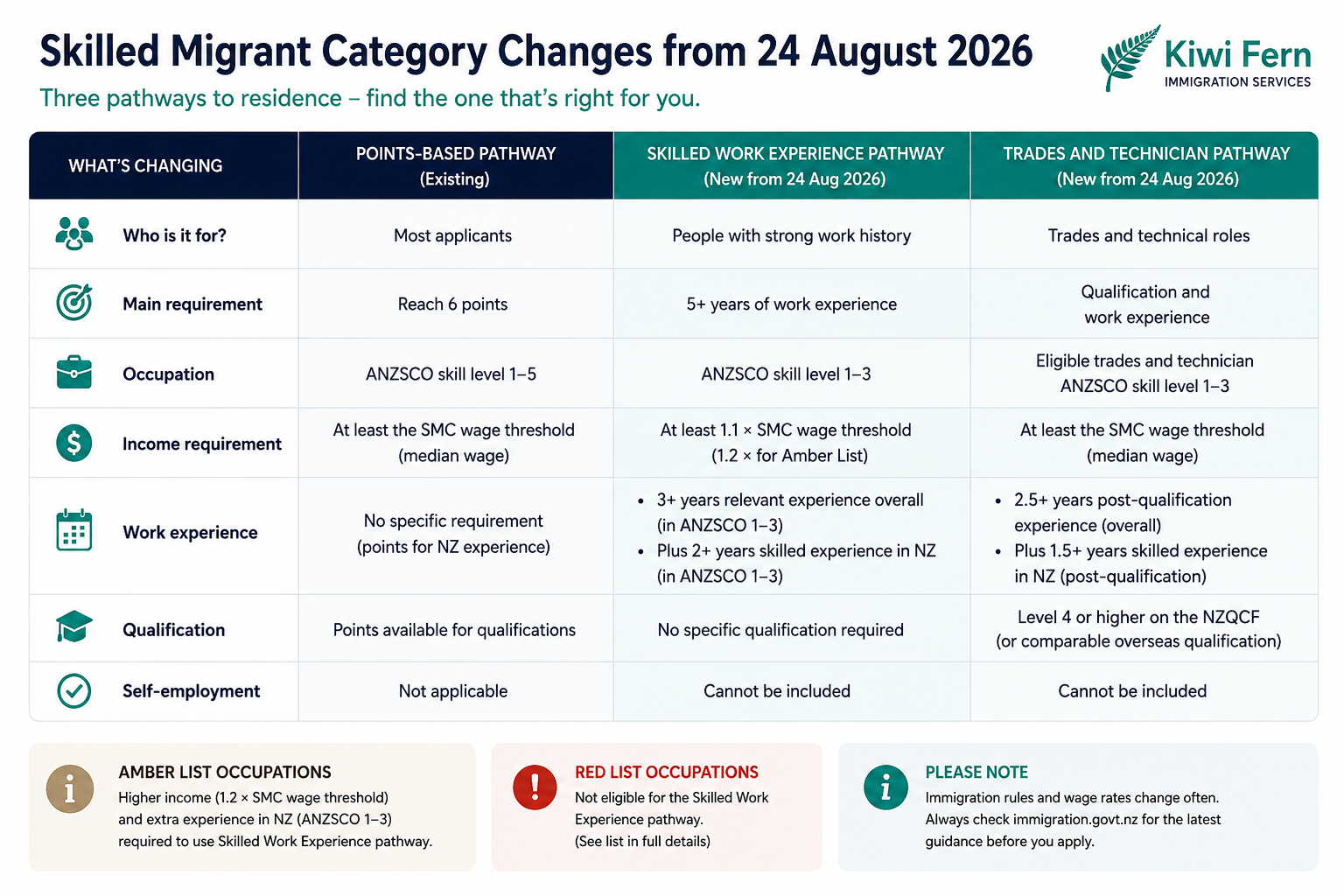
From 24 August 2026, Immigration New Zealand will be introducing changes to the SMC, including:
- 2 new SMC pathways, alongside the existing Points-based pathway
- updates to the Points-based pathway, and
- changes to the SMC wage threshold (median wage) rules.
Who is affected
You may be affected if you:
- are already working in New Zealand and planning to apply for an SMC Resident Visa
- are relying on a qualification to get points
- do not currently meet the 6-point threshold, or
- work in a trades or technician role.
New SMC pathways
From 24 August 2026, 2 new pathways will be added to the SMC: the Skilled Work Experience pathway and the Trades and Technician pathway.
| Pathway | Who is it for | Main requirements |
|---|---|---|
| Points-based | Most applicants | Reach 6 points |
| Skilled Work Experience | People with strong work history | 5+ years of work experience |
| Trades and Technician | Trades and technical roles | Qualification and work experience |
Skilled Work Experience pathway
Under the current rules you can use skilled work experience in New Zealand to reach the 6-point threshold, if you do not have enough points from your income, qualification or occupational registration alone.
From 24 August 2026 a new pathway will be available for the SMC that allows you to gain residence from work experience alone. This will be separate to the Points-based pathway.
You will be eligible for the Skilled Work Experience pathway if you:
- work in or have a job offer for an ANZSCO skill level 1 to 3 occupation paid at least 1.1 times the SMC wage threshold (median wage)
- have at least 3 years of relevant work experience in an ANZSCO skill level 1 to 3 occupation, and
- have an additional 2 years of skilled work experience in New Zealand in an ANZSCO skill level 1 to 3 occupation paid at least 1.1 times the SMC median wage (median wage threshold).
Tip
Relevant work experience is work experience related to your current job or job offer. Skilled work experience is work experience related to your current job or job offer, completed in New Zealand and paid at the required amount.
If your current job or job offer is on the Amber List, there are additional requirements you must meet to be eligible for this pathway.
If your current job or job offer is on the Red List, or is an ANZSCO skill level 4 or 5 occupation, you will not be eligible for this pathway.
You can not include self-employment as relevant work experience.
Amber list occupations
Applicants with a job or job offer in these occupations will need to:
- be paid at least 1.2 times the SMC wage threshold, and
- have at least 3 years of relevant work experience in New Zealand in an ANZSCO skill level 1 to 3 occupation, and
- have an additional 2 years of skilled work experience in New Zealand in an ANZSCO skill level 1 to 3 occupation paid at least 1.2 times the SMC wage threshold (median wage).
| ANZSCO code | Occupation |
|---|---|
| 141999 | Accommodation and Hospitality Manager nec |
| 141311 | Hotel or Motel Manager |
| 431411 | Hotel Service Manager |
| 351111 | Baker |
| 141911 | Bed and Breakfast Operator |
| 141111 | Cafe or Restaurant Manager |
| 141211 | Caravan Park and Camping Ground Manager |
| 351311 | Chef |
| 149212 | Customer Service Manager |
| 313112 | ICT Customer Support Officer |
| 313199 | ICT Support Technicians nec |
| 512111 | Office Manager |
| 351112 | Pastrycook |
| 313113 | Web Administrator |
Red list occupations
These occupations are not eligible for the new Skilled Work Experience pathway:
| ANZSCO code | Occupation |
|---|---|
| 451111 | Beauty Therapist |
| 142114 | Hair or Beauty Salon Manager |
| 391111 | Hairdresser |
| 149999 | Hospitality, Retail and Service Manager nec |
| 411611 | Massage Therapist |
| 142111 | Retail Manager (General) |
Trades and Technician pathway
From 24 August 2026 a new pathway will be available for people with trades and technician occupations.
You will be eligible for the Trades and Technician pathway if you:
- work in an eligible trades and technician occupation paid at least the SMC wage threshold (median wage)
- have a relevant qualification that is level 4, comparable to level 4, or higher than level 4 on the NZQCF (New Zealand Qualifications and Credentials Framework)
- have at least 2.5 years of relevant, post-qualification work experience in an ANZSCO skill level 1 to 3 occupation, and
- have an additional 1.5 years of post-qualification, skilled work experience in New Zealand paid at least the SMC wage threshold (median wage).
Eligible occupations for the SMC Trades and Technician pathway (August 2026)
Tips
Relevant work experience is work experience related to your current job or job offer. Skilled work experience is work experience related to your current job or job offer, completed in New Zealand and paid at the required amount.
You cannot include self-employment as relevant work experience.
Credit requirements for New Zealand qualifications
If you have a New Zealand qualification, it must be either:
- at least 120 credits on the NZQCF, or
- less than 120 credits but with multiple prerequisite qualifications that together make at least 120 credits.
If you were awarded credits in recognition of prior learning, they will not count towards the 120-credit requirement.
If you have an overseas qualification it must be level 4 or higher, but there are no credit requirements.
Evidence of qualifications
You will need to provide evidence of your qualification.
Overseas qualifications: If you have an overseas qualification, you will need to have an International Qualification Assessment (IQA) from the New Zealand Qualifications Authority (NZQA). When you apply for residence you will need to provide a copy of the qualification certificate and the IQA. Check if you need an International Qualification Assessment
New Zealand qualifications: If you have a New Zealand qualification, you will need to provide a copy of the qualification certificate and an academic transcript (or equivalent) when you apply for residence.
Timeframe for gaining work experience
You must have gained your work experience for the Skilled Work Experience or Trades and Technician pathway within a set timeframe.
For relevant work experience this timeframe is 10 years, counted back from the date you apply for residence. For example, if you need 3 years of relevant work experience, this experience must have been gained within the 10 years immediately before you apply for residence.
For skilled work experience this timeframe is twice as long as the amount of experience you need, counted back from the date you apply for residence. For example, if you need 2 years of skilled work experience, this experience must have been gained within the 4 years immediately before you apply for residence.
Points-based pathway
The current SMC allows you to claim points towards New Zealand residence if you have 1 of the following:
- an occupational registration that requires at least 2 years of training
- a level 7 bachelor's degree or higher, based on the NZQCF levels, or
- you are paid at least 1.5 times the median wage.
You must have a total of 6 points and a skilled job or job offer to apply. Skilled Migrant Category Resident Visa
Changes to the Points-based pathway
From 24 August 2026 you will be able to:
- get extra points for New Zealand qualifications
- get more points for overseas bachelor's degrees and postgraduate certificates, and
- reach the 6-point threshold with less New Zealand work experience.
Extra points for some qualifications
From 24 August 2026 you will be able to get extra points for New Zealand qualifications. You will also be able to get 4 points for a bachelor's degree or post-graduate certificate gained outside of New Zealand (3 points under the current rules). You will also need to have a bachelor's degree for some higher-level qualifications.
| Qualification | Points awarded from 24 August 2026 | Bachelor's degree required |
|---|---|---|
| Doctoral degree | 6 | No |
| New Zealand master's degree (30 weeks of full-time study) | 6 | Yes |
| New Zealand master's degree | 5 | No |
| Master's degree gained outside New Zealand | 5 | Yes |
| New Zealand honours degree, post-graduate diploma or post-graduate certificate | 5 | Yes |
| New Zealand bachelor's degree | 5 | Not applicable |
| Honours degree, post-graduate diploma or post-graduate certificate gained outside New Zealand | 4 | Yes |
| Bachelor's degree gained outside New Zealand | 4 | Not applicable |
Evidence of qualifications: You will need to provide evidence of any qualifications you claim points for.
Overseas qualifications: If you claim points for an overseas qualification, you must provide an International Qualification Assessment (IQA) from the New Zealand Qualifications Authority (NZQA), unless the qualification is listed on the List of Qualifications Exempt from Assessment (LQEA). Check if you need an International Qualification Assessment
New Zealand qualifications: If you claim points for a New Zealand qualification, you must provide a copy of the qualification certificate.
You can claim 6 points for a New Zealand master's degree if you have completed at least 30 weeks of full-time study in New Zealand and have a bachelor's degree.
You can only claim 5 points for a New Zealand master's degree if you have not completed 30 weeks of full-time study in New Zealand or do not have a bachelor's degree.
Supporting bachelor's degree for a level 8 or 9 qualification: If you claim points for a level 8 or 9 qualification and your bachelor's degree is only being used as a supporting qualification, you will not need to provide an IQA for the bachelor's degree. You must provide the bachelor's degree certificate, and the academic transcript.
Combined master's degrees: If you claim points for a combined master's degree, you will only need to provide the academic transcript as evidence of the bachelor's degree.
Lower work experience requirements
Under the current rules you can claim up to 3 additional points from work experience in New Zealand, if you cannot reach 6 points with your occupational registration, qualification or income.
From 24 August 2026 Immigration New Zealand will reduce the amount of work experience in New Zealand you need to gain additional points.
| Work experience in New Zealand required | Points awarded currently | Points awarded from 24 August 2026 |
|---|---|---|
| 3 years | 3 | Not applicable |
| 2 years | 2 | 3 |
| 1.5 years | 1 | 2 |
| 1 year | 1 | 1 |
New occupational registration for accountants
From 24 August 2026, you will be able to claim 6 points for the Points-based pathway if:
- you are an accountant who can undertake the work of a Qualified Statutory Accountant in New Zealand, and
- you are a member of Certified Practising Accountants (CPA) Australia.
Types of membership, CPA Australia
English language tests for eligible occupational registrations
From 24 August 2026, your English language test results will be valid for 5 years instead of 2 years if you have an eligible occupational registration. Claiming skilled resident points from occupational registration
If you are including your partner in your SMC Resident Visa application, their English language test results will also be valid for 5 years if they have an eligible occupational registration.
Changes to the SMC wage threshold (median wage) rules
From 24 August 2026, Immigration New Zealand is changing the way it calculates the SMC wage threshold (median wage).
The current rules
The SMC wage threshold is based on the median wage and is updated each year.
Under the current rules you must meet the SMC wage threshold:
- in your current job or job offer, and
- during any skilled work experience in New Zealand that you are using to claim points.
Pay rates for the Skilled Migrant Category Resident Visa
How your threshold is determined under the current rules
For your current job or job offer you must meet the SMC wage threshold that is in place when you submit your expression of interest (EOI).
For your skilled work experience you must meet the SMC wage threshold that was in place when you started gaining skilled work experience. If you change jobs while gaining work experience, your new job must meet the threshold that is in place when you start that job. This may be higher than the previous threshold, as it increases over time.
Changes from 24 August 2026
From 24 August 2026 you will only need to meet the SMC wage threshold that was in place when you started gaining skilled work experience. This means that your current job or job offer must meet the rate that applied at that time.
This change also applies to the new Skilled Work Experience and Trades and Technician pathways.
If you do not need skilled work experience for your pathway, for example you are claiming 6 points for a doctoral degree, you need to meet the threshold in effect for your pathway at the time you are invited to apply for residence (which is usually the same date that you submit your EOI).
If you change jobs
For most people, you will not need to meet a higher SMC wage threshold if you change jobs.
You may need to meet a higher SMC wage threshold if you apply under the Points-based pathway and are changing jobs from a skill level 1 to 3 occupation to a skill level 4 or 5 occupation.
Example: Meeting the SMC wage threshold
Max is applying for an SMC Resident Visa under the Points-based pathway and wants to claim 1 point for skilled work experience. He has an ANZSCO skill level 1 to 3 occupation. Max first started his skilled work experience in November 2025 where he was paid NZD $34 an hour. The SMC wage threshold for this period is NZD $33.56 an hour. As he earns more than this, Max will meet the wage requirement for his skilled work experience.
If Max is invited to apply in October 2026, his current skilled job needs to meet the rate that was in place when he started gaining his skilled work experience ($33.56). His current job pays NZD $34 an hour. He will meet the wage requirement.
Timeframe for setting your SMC wage threshold
The skilled work experience used to set your SMC wage threshold must fall within the eligible timeframe. This timeframe is twice the amount of experience you need, counted back from the date you are invited to apply.
For example, if you need 2 years of skilled work experience, the earliest you can set your SMC wage threshold is 4 years before you are invited to apply.
Example: Timeframe for setting your SMC wage threshold
Amira wants to claim 1 point for skilled work experience, under the Points-based pathway. This means she will need 1 year of skilled work experience, within 2 years.
She is planning to submit her EOI on 10 September 2026. The eligible timeframe in which Amira can set her wage threshold is from 10 September 2024 to 10 September 2026.
Amira has had 2 jobs in New Zealand, both in skill level 2 occupations. She started working in her first job from 1 April 2023 until 1 April 2025 and was paid NZD $32.00 at the time. This was above the SMC wage threshold in effect when she first started working (NZD $29.66), however, some of her work was not within the eligible timeframe of 2 years. Her SMC wage threshold is set on 10 September 2024 at NZD $31.61, which is the start of the eligible timeframe for setting her SMC wage threshold.
She started her current job, also in a skill level 2 occupation, on 5 October 2025 and is paid NZD $40.20. This is above the SMC wage threshold of NZD $31.61 (that was set on 10 September 2024).
Grace period
From 24 August 2026, a new grace period rule will apply. This is for situations where the SMC wage threshold increases between your work visa being granted and starting your skilled work experience.
When it applies: The grace period applies if:
- you started working within 5 months of your work visa being granted
- there was a change in threshold between your work visa being granted and your skilled work experience starting, and
- your skilled work experience is within the eligible timeframe to set your wage threshold for your pathway.
Example: Grace period
Peter is applying under the Skilled Work Experience Pathway. His occupation is not on the Amber List, so he must be paid 1.1 times the SMC wage threshold. He was granted his work visa on 23 February 2024. The threshold at this time was $32.62 an hour.
He began working on 1 May 2024 and was paid $34.56 an hour. The threshold at this time had increased to $34.77 an hour. As he started working within 5 months of receiving his work visa, he only needs to meet the rate in effect on his work visa grant date ($32.62 an hour).
SMC wage threshold rates for Trades and Technician and Skilled Work Experience pathways
If you apply for an SMC Resident Visa under one of the new pathways, you must meet the relevant hourly pay amount for your:
- skilled work experience in New Zealand, and
- current job or job offer.
The amount that you must meet will depend on when you started gaining skilled work experience (and if it was within the eligible timeframe).
| Date range | Trades and Technician pathway (the SMC wage threshold) | Skilled Work Experience pathway (1.1 times the SMC wage threshold) | Amber list roles for the Skilled Work Experience pathway (1.2 times the SMC wage threshold) |
|---|---|---|---|
| From 9 March 2026 | NZD $35.00 | NZD $38.50 | NZD $42.00 |
| 18 August 2025 to 8 March 2026 | NZD $33.56 | NZD $36.91 | NZD $40.27 |
| 28 February 2024 to 17 August 2025 | NZD $31.61 | NZD $34.77 | NZD $37.93 |
| 27 February 2023 to 27 February 2024 | NZD $29.66 | NZD $32.62 | NZD $35.59 |
| 24 October 2022 to 26 February 2023 | NZD $27.76 | NZD $30.53 | NZD $33.31 |
| 19 July 2021 to 23 October 2022 | NZD $27.00 | NZD $29.70 | NZD $32.40 |
| 24 February 2020 to 18 July 2021 | NZD $25.50 | NZD $28.05 | NZD $30.60 |
If you apply for an SMC Resident Visa under the Points-based pathway, the pay rates below will not change on 24 August 2026.
Pay rates for skilled work in New Zealand (Points-based pathway)
Your current job or job offer must pay at least the pay rate required at the time you submit your EOI and application. This is based on the ANZSCO (Australian and New Zealand Standard Classification of Occupations) skill level of the job, and a minimum pay rate based on the hourly median wage.
| Date range | ANZSCO skill levels 1 to 3 (the median wage) | ANZSCO skill levels 4 and 5 (150% of the median wage) | Jobs not listed in ANZSCO (150% of the median wage) |
|---|---|---|---|
| From 9 March 2026 | NZD $35.00 | NZD $52.50 | NZD $52.50 |
| 18 August 2025 to 8 March 2026 | NZD $33.56 | NZD $50.34 | NZD $50.34 |
| 28 February 2024 to 17 August 2025 | NZD $31.61 | NZD $47.41 | NZD $47.41 |
| 27 February 2023 to 27 February 2024 | NZD $29.66 | NZD $44.49 | NZD $44.49 |
| 24 October 2022 to 26 February 2023 | NZD $27.76 | NZD $41.64 | NZD $41.64 |
| 19 July 2021 to 23 October 2022 | NZD $27.00 | NZD $40.50 | NZD $40.50 |
| 24 February 2020 to 18 July 2021 | NZD $25.50 | NZD $38.25 | NZD $38.25 |
| 26 November 2018 to 23 February 2020 | NZD $25.00 | NZD $37.50 | NZD $37.50 |
| 15 January 2018 to 25 November 2018 | NZD $24.29 | NZD $36.44 | NZD $36.44 |
Pay rates to claim points for income
You must earn at least the current pay rate required for the points you want to claim for income. For example, if you want to claim 4 points for income, you must be earning at least NZD $70.00 an hour. If you are also claiming points for skilled work experience in New Zealand, you must meet the pay rate required for the income points you are claiming throughout your work experience period.
| Date range | 3 points (1.5 times the median wage) | 4 points (2 times the median wage) | 6 points (3 times the median wage) |
|---|---|---|---|
| From 9 March 2026 | NZD $52.50 | NZD $70.00 | NZD $105.00 |
| 18 August 2025 to 8 March 2026 | NZD $50.34 | NZD $67.12 | NZD $100.68 |
| 28 February 2024 to 17 August 2025 | NZD $47.41 | NZD $63.22 | NZD $94.83 |
| 27 February 2023 to 27 February 2024 | NZD $44.49 | NZD $59.32 | NZD $88.98 |
| 24 October 2022 to 26 February 2023 | NZD $41.64 | NZD $55.52 | NZD $83.28 |
| 19 July 2021 to 23 October 2022 | NZD $40.50 | NZD $54.00 | NZD $81.00 |
| 24 February 2020 to 18 July 2021 | NZD $38.25 | NZD $51.00 | NZD $76.50 |
| 26 November 2018 to 23 February 2020 | NZD $37.50 | NZD $50.00 | NZD $75.00 |
| 15 January 2018 to 25 November 2018 | NZD $36.44 | NZD $48.58 | NZD $72.87 |
Pay rates to claim skilled work experience (Points-based pathway)
To claim points for skilled work experience, you must meet the hourly pay rate requirement in effect at the start of the work experience period you are claiming points for.
- Use Table 6 if you are claiming points for work experience but not income.
- Use Table 7 if you are claiming points for income as well as work experience.
If the median wage increases during this period your income does not need to increase, as long as you stay in the same job. If you change jobs, you must meet the new wage threshold applicable at that time.
Changes to other skilled residence visas
The changes to wage threshold rules will also apply to other skilled residence visas such as the Work to Residence Visa, Transport Work to Residence Visa and Care Workforce Work to Residence Visa. 2026 changes to wage rate rules for work to residence visas
Draft EOIs
Draft expressions of interest (EOIs) will expire on 24 August 2026.
Immigration New Zealand is making changes to the SMC EOI form on 24 August 2026. If you want to apply for an SMC Resident Visa under the current rules you must submit your EOI before 24 August.
Any draft (unsubmitted) EOIs will expire on 24 August 2026 and be deleted. If your EOI is deleted, you need to start your EOI again using the new form which will be available from 24 August 2026.
What you can do now
Before 24 August 2026, you can:
- Check if you may qualify under a new pathway
- Review your qualifications and work experience
- consider whether you need an International Qualification Assessment (IQA), and
- Talk to your employer about your pay and role.
Sources and further reading
This article is adapted from Immigration New Zealand's official guidance, reused under the Creative Commons Attribution 3.0 New Zealand Licence, and is credited to the Crown and the Ministry of Business, Innovation and Employment.
- 2026 changes to the Skilled Migrant Category Resident Visa, Immigration New Zealand
- Pay rates for the Skilled Migrant Category Resident Visa, Immigration New Zealand
Talk to us
If you want help working out which SMC pathway applies to you, whether your role sits on the Amber or Red List, or what evidence to gather before your EOI, Book a Paid Consultation with Kiwi Fern Immigration Services.