

Engineer Salary in New Zealand 2026: What You Will Actually Earn
If you are an engineer thinking about working in New Zealand, the first question is almost always "what will I be paid?" The second is "is the salary good enough to make the move worth it?"
This guide answers both, with current salary data by discipline, experience level, and city, plus a clear-eyed look at how engineering salaries map onto Green List residency pathways and the cost of living in New Zealand's main cities.
Quick answer
The median full-time engineer in New Zealand earns approximately NZD $105,000 per year. Civil and structural engineers in Auckland or Wellington with 5-10 years of experience typically earn NZD $115,000 to $140,000. Graduate engineers start around NZD $65,000 to $80,000. Most engineering disciplines sit on New Zealand's Green List Tier 1, which means qualified candidates can apply for the Straight to Residence visa: a direct path to permanent residence, no work-to-residence stage required.
Engineer salary by experience level
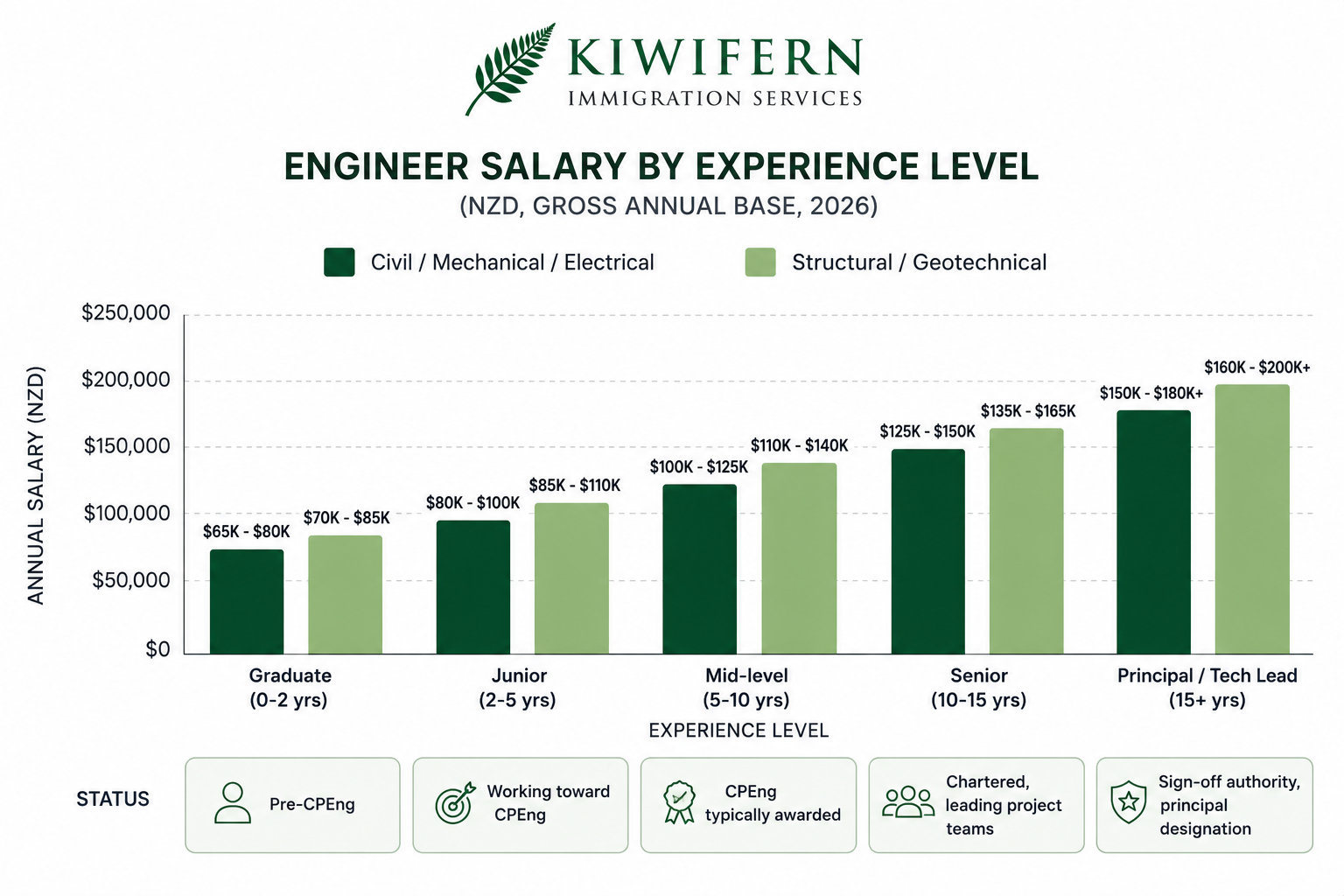
The following figures are the typical base salary range for full-time, salaried engineers across mainstream disciplines. They exclude bonuses, KiwiSaver employer contributions, and benefits, which usually add 5-12 percent on top.
| Level | Civil / Mechanical / Electrical | Structural / Geotechnical | Status |
|---|---|---|---|
| Graduate (0-2 yrs) | $65,000 - $80,000 | $70,000 - $85,000 | Pre-CPEng |
| Junior (2-5 yrs) | $80,000 - $100,000 | $85,000 - $110,000 | Working toward CPEng |
| Mid-level (5-10 yrs) | $100,000 - $125,000 | $110,000 - $140,000 | CPEng typically awarded |
| Senior (10-15 yrs) | $125,000 - $150,000 | $135,000 - $165,000 | Chartered, leading project teams |
| Principal / Tech Lead (15+ yrs) | $150,000 - $180,000+ | $160,000 - $200,000+ | Sign-off authority, principal designation |
Reading the table: a graduate civil engineer in Auckland typically starts at NZD $70,000 to $78,000 in the current market. By year 5 they are usually at NZD $90,000 to $105,000, depending on chartership progress and the size of the firm. Senior engineers with leadership responsibility, or specialist engineers in high-demand disciplines like geotechnical or structural, frequently earn NZD $150,000+.
Becoming Chartered (CPEng or IntPE(NZ)) typically lifts salary by NZD $8,000 to $15,000 once awarded, and is the gating criterion for many senior and project lead roles.
Engineer salary by discipline
Salary varies meaningfully by engineering discipline. The biggest pay gaps come from market demand, not technical difficulty: New Zealand has acute shortages in some areas (structural, geotechnical, electrical) and surplus in others (recent civil graduates in Auckland).
| Discipline | Median | Range | Demand | Green List |
|---|---|---|---|---|
| Civil Engineer | $105,000 | $95,000 - $120,000 | High (Auckland infrastructure, Christchurch rebuild) | Tier 1 (Straight to Residence) |
| Structural Engineer | $120,000 | $110,000 - $140,000 | Acute shortage | Tier 1 |
| Geotechnical Engineer | $125,000 | $115,000 - $145,000 | Acute shortage | Tier 1 |
| Electrical Engineer | $115,000 | $100,000 - $135,000 | High (renewables, transmission) | Tier 1 |
| Mechanical Engineer | $105,000 | $95,000 - $120,000 | Moderate | Tier 1 |
| Chemical / Process Engineer | $115,000 | $100,000 - $140,000 | Niche but well-paid | Tier 1 |
| Environmental Engineer | $100,000 | $90,000 - $115,000 | Growing (climate adaptation, water) | Tier 1 |
| Industrial / Production Engineer | $100,000 | $90,000 - $115,000 | Moderate | Tier 1 |
Notes:
- Software engineering is its own market with very different dynamics; we cover it separately in our IT salary guide.
- Petroleum and mining engineering numbers are higher than the table suggests for senior consulting and operator roles, but the broader NZ market for these is small.
- Chemical and process engineers in Taranaki (oil and gas) earn meaningfully more than the table average.
Engineer salary by city
The three big employment centres for engineering work are Auckland, Wellington, and Christchurch. Tauranga and Hamilton are growing in infrastructure roles. Salaries are highest in Auckland on average, but cost of living offsets a chunk of that uplift, especially in housing.
| City | Median | Range | Cost-of-living index | Demand |
|---|---|---|---|---|
| Auckland | $115,000 | $100,000 - $135,000 | 100 (baseline) | Highest (largest job market) |
| Wellington | $110,000 | $100,000 - $130,000 | ~88 | High (government infrastructure, transport) |
| Christchurch | $105,000 | $95,000 - $125,000 | ~78 | High (post-quake rebuild ongoing) |
| Hamilton | $100,000 | $90,000 - $115,000 | ~75 | Moderate, growing (Waikato infrastructure) |
| Tauranga | $100,000 | $90,000 - $115,000 | ~80 | Moderate, growing (port and housing) |
Cost-of-living context: median weekly rent in Auckland for a 3-bedroom house is around NZD $650 to $750 (Stats NZ, 2024 data). Wellington is slightly lower; Christchurch is materially lower at NZD $450 to $550. A senior engineer earning NZD $135,000 in Christchurch keeps more of their pay packet than the same role at NZD $150,000 in Auckland. See our cost of living guide for a fuller breakdown.
How engineer salaries map to Green List residency
Most mainstream engineering disciplines sit on Tier 1 of New Zealand's Green List, which means qualified candidates can apply for the Straight to Residence visa: direct permanent residence, no two-step pathway. This is one of the strongest reasons engineering remains a top route for skilled migration to New Zealand.
| Tier 1 - Straight to Residence | Tier 2 - Work to Residence (24 months) |
|---|---|
|
|
Always check the current Green List at immigration.govt.nz before lodging an application: occupations and tier assignments are reviewed approximately every 12 months.
To use the Tier 1 Straight to Residence pathway, you need:
- A job offer from a New Zealand employer for a role that meets the listed occupation
- The qualification specified for that occupation (usually a 4-year engineering degree assessed as equivalent by the New Zealand Qualifications Authority)
- Chartered Professional Engineer (CPEng) or international equivalent, where the role is at a senior level
- Pay at or above the applicable wage threshold. The immigration median wage was updated to NZD $35.00 per hour from 9 March 2026 (Stats NZ June 2025 data). Green List occupations without a specific occupation pay rate must pay at or above the median wage; some occupations have higher specific thresholds.
For engineers who do not yet have a job offer, the Accredited Employer Work Visa (AEWV) is the standard entry route. Once you have worked for an accredited employer and meet the income threshold, you can transition into residence.
Salary trajectory: what to expect over 10 years
A realistic path for an engineer migrating to New Zealand at age 28 with a recognised foreign degree and 5 years of experience:
- Year 1: Land a role at NZD $95,000 to $105,000 on an AEWV. Most foreign-trained engineers take a small initial paycut while they build local experience and progress toward CPEng.
- Years 2-3: Move to NZD $110,000 to $125,000 as you complete the local industry orientation and start leading project elements. Lodge Straight to Residence application if you are on a Tier 1 occupation, or progress toward Work to Residence if Tier 2.
- Years 4-5: NZD $125,000 to $145,000 as a Senior Engineer. CPEng typically awarded around this point if pursued. Permanent residence usually granted by year 3-4 on the Green List pathway.
- Years 6-10: NZD $145,000 to $180,000 for a Principal Engineer or technical lead. Six-figure consulting day rates are common for chartered specialists in geotechnical, structural, and electrical disciplines.
These numbers are realistic but not guaranteed. They assume continuous employment, completion of CPEng if pursued, and demand staying broadly where it is in 2026. They do NOT include relocation allowances, sign-on bonuses, or equity participation, which are common at senior levels in private consulting firms.
Tax and take-home pay
Engineer salaries above are gross. New Zealand income tax is progressive:
| Income | Rate |
|---|---|
| Up to NZD $15,600 | 10.5% |
| NZD $15,601 to $53,500 | 17.5% |
| NZD $53,501 to $78,100 | 30.0% |
| NZD $78,101 to $180,000 | 33.0% |
| Above NZD $180,000 | 39.0% |
Plus ACC earner levy (rate adjusts annually around 1 April; FY 2025-26 maximum liable earnings was $142,283; FY 2026-27 cap is $152,790 per MBIE). Plus KiwiSaver (optional; default 3% employee with 3% employer minimum match). Disclaimer: tax rates and ACC levies change. Confirm current figures with ird.govt.nz and acc.co.nz before relying on a take-home estimate.
A NZD $120,000 engineer takes home roughly NZD $87,000 to $88,000 after tax and ACC, before KiwiSaver, on the rates above. Use the official PAYE calculator at ird.govt.nz/tools-and-calculators for your specific situation.
How to negotiate engineer salary in New Zealand
Three things matter most:
- Bring evidence. New Zealand engineering hiring managers expect data: comparable role offers, your project portfolio with quantified outcomes, and where you sit in published salary surveys (Hays, Robert Walters, Beca, Aurecon graduate scales). Vague claims of "market rate" do not move the needle.
- Negotiate the package, not just the base. Look for: relocation allowance (NZD $5,000 to $15,000 is normal for international hires), CPEng course and exam funding, professional development budget, vehicle or vehicle allowance for site-based roles, and sign-on bonus.
- Time it right. The strongest leverage is at offer stage and at chartership. Asking for a 10 percent rise in your second month of a new role is usually rejected; asking at six months alongside your first formal review, with completed deliverables, usually succeeds.
Frequently asked questions
Is engineering a good career for migration to New Zealand?
Yes, for most disciplines. Engineering occupations dominate the Tier 1 Green List, which means qualified engineers can pursue Straight to Residence rather than the longer Work to Residence pathway. Salaries are competitive with most of Europe and lower than the United States or Australia, but the lifestyle and immigration speed are usually the deciding factors.
Can I get a New Zealand engineering job from overseas?
Yes. Several major engineering consultancies in New Zealand (including Beca, Aurecon, WSP, Stantec) recruit at senior and chartered levels, sometimes from overseas. Graduate roles are usually filled locally. Apply directly through company sites and through Seek NZ. Confirm any prospective employer is AEWV-accredited before applying; the official Immigration New Zealand accredited employer list is the source of truth.
Do I need to be a Chartered Professional Engineer (CPEng) to work in New Zealand?
Not for most roles. CPEng is required for some specific scopes (sign-off on producer statements for building consents, principal engineer designation in regulated disciplines), and is a strong career and salary differentiator at senior levels. Many engineers in industry never become chartered.
Will my overseas engineering degree be recognised?
Engineering New Zealand recognises degrees accredited under the Washington Accord (4-year engineering bachelor degrees), Sydney Accord (3-year engineering technologist programmes), and Dublin Accord (2-year engineering technician programmes). India became a full Washington Accord signatory in June 2014, BUT only programmes accredited by India's National Board of Accreditation (NBA) at NBA-accredited institutions are covered. A large share of Indian engineering programmes are NOT NBA-accredited, so the accord does not automatically apply to them. Indian engineers should therefore expect to (a) run a credential check with Engineering New Zealand (engineeringnz.org/join-us/immigration/credential-check/) to confirm their specific programme is recognised, and (b) obtain an NZQA International Qualifications Assessment if their qualification is not on the List of Qualifications Exempt from Assessment (LQEA). The LQEA was expanded on 23 June 2025 to include IIT and IISER, which removes the NZQA step for graduates of those institutions. Allow 3-6 months for the combined recognition process.
What is the highest-paying engineering discipline in New Zealand?
Senior structural and geotechnical engineers, especially those leading large infrastructure projects, are consistently the top-paid in the salaried market. In specialised industry settings (oil and gas in Taranaki, mining consulting), individual roles can pay materially more.
How does engineer salary in New Zealand compare to Australia?
Australian engineer salaries are typically 15-25 percent higher than New Zealand at every experience level, but cost of living in Sydney and Melbourne offsets much of this. Many New Zealand-trained engineers move to Australia after building experience locally, especially in mining and oil and gas. We help clients work through this trans-Tasman question; see our Australia services page.
What is the median engineer salary in New Zealand?
The median full-time engineer salary in New Zealand in 2026 is approximately NZD $105,000 per year, based on Hays and Robert Walters salary surveys. Civil and structural engineers tend to earn slightly above median; recent graduates and entry-level roles sit below it.
Are there engineer shortages in New Zealand right now?
Yes. Structural, geotechnical, electrical, and infrastructure engineers are all in active shortage. Most are on the Tier 1 Green List, which is why the migration pathway is straightforward for qualified candidates.
Talk to Kiwi Fern about your engineering migration
If you are an engineer planning a move to New Zealand and you want a realistic read on your visa path, salary expectations, and timeline, we can help. Our team has 20+ years of experience guiding engineers through Straight to Residence and AEWV applications.