
New Zealand Resident Visa Statistics 2025/26: What the Latest INZ Data Tells Us
Immigration New Zealand has released updated resident visa decision statistics covering the current financial year up to 31 May 2026. The numbers give a clear picture of who is gaining residence in New Zealand, which pathways are growing, and where approval rates sit right now. Here is what stands out.
The headline numbers
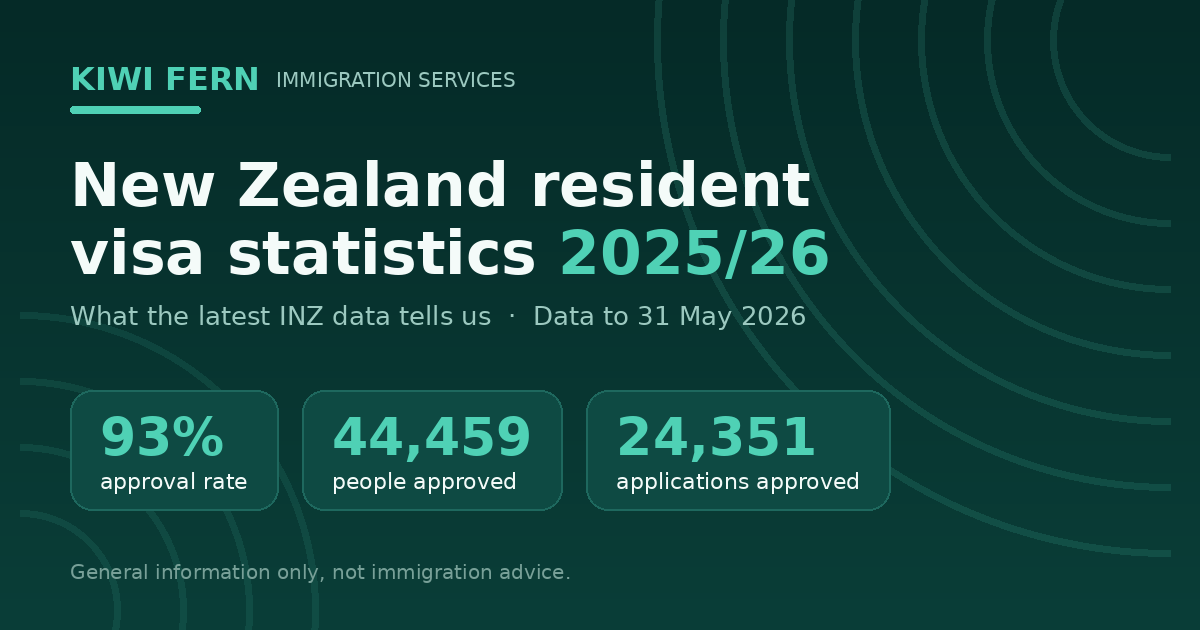
In the first eleven months of the 2025/26 financial year (1 July 2025 to 31 May 2026), INZ decided 26,253 resident visa applications. Of these, 24,351 were approved and 1,902 were declined. That works out to an approval rate of around 93 percent.
Counted by people rather than applications, 44,459 individuals were approved for residence over the same period, out of 48,394 people included in decided applications.
Decision volumes have settled well below the record levels of 2022/23, when the one-off 2021 Resident Visa pushed the total to more than 86,000 applications decided. The current year looks more like a return to steady, business-as-usual processing.
Partnership remains the largest single category
Partnership continues to be the biggest residence pathway by a wide margin. In 2025/26 so far, 7,895 partnership applications have been approved, with a further 700 approvals under the Partner of an Expatriate category. If you are applying for residence based on your relationship with a New Zealand citizen or resident, the volumes show this remains a well-used and consistently processed pathway.
Skilled pathways are shifting
The data shows a clear transition in how skilled migrants gain residence:
- The new Skilled Migrant Category (SMC Skilled Residence) is growing quickly. Approvals rose from 2,102 in the full 2024/25 year to 3,024 in just eleven months of 2025/26. Monthly approvals have climbed steadily through the year, reaching over 800 approvals in some recent months.
- Straight to Residence remains a major pathway with 3,971 approvals so far this year, although volumes are lower than the previous two years as the initial surge of Green List applicants works through the system.
- Green List Work to Residence has more than doubled, from 472 approvals in 2024/25 to 1,038 so far in 2025/26. This reflects applicants who completed their two years of work in Green List Tier 2 roles now becoming eligible.
- Sector work to residence pathways are also maturing. Care Workforce approvals reached 1,297 (up from 589 last year) and Transport Sector approvals reached 575 (up from 230).
- The old Skilled Migrant Category is effectively finished, with only 27 approvals this year as the last legacy applications are completed.
Family and parent categories
Beyond partnership, 1,692 parent category applications were approved so far in 2025/26, slightly ahead of last year's pace. Dependent child approvals sit at 1,387, and Parent Retirement added 223 approvals. Family pathways remain a meaningful share of the residence programme.
India remains the number one source country
For yet another year, India is the largest source of new residents. In 2025/26 so far, 5,186 applications from Indian nationals were approved, covering 8,361 people. China follows with 3,422 approved applications, then the Philippines with 3,047. The United Kingdom, South Africa, the United States, Fiji and Sri Lanka round out the leading source countries.
For Indian students and skilled workers considering New Zealand, the data confirms that the pathway from study or skilled work to residence continues to deliver real outcomes at scale.
Investor pathways gaining traction
The refreshed Active Investor Plus categories (Growth and Balanced) recorded 336 application approvals in their first year of meaningful volumes, covering 1,104 approved investors and family members. This suggests the redesigned investor settings are attracting genuine interest.
What this means for applicants
The overall picture is positive. Approval rates are high, skilled pathways are processing at growing volumes, and monthly decision numbers are steady. That said, a 93 percent approval rate still means around 1,900 applications were declined this year. Declines are most often the result of incomplete evidence, misunderstood policy requirements, or applying under the wrong category. Careful preparation matters.
Frequently asked questions
What is the current approval rate for New Zealand resident visas?
Based on INZ data for 1 July 2025 to 31 May 2026, around 93 percent of decided resident visa applications were approved.
Which residence pathway is the most common?
Partnership is the largest single category, followed by Straight to Residence and the Skilled Migrant Category (SMC Skilled Residence).
Is the new Skilled Migrant Category working?
Approval volumes under SMC Skilled Residence have grown strongly, from 2,102 approvals in 2024/25 to 3,024 in the first eleven months of 2025/26.
Which countries do most new residents come from?
India is the largest source country, followed by China, the Philippines, the United Kingdom and South Africa.
Disclaimer
This article is general information only and is not immigration advice. Immigration policy and processing volumes change regularly. For advice on your specific situation, speak with one of Kiwi Fern's licensed immigration advisers.
Source: Immigration New Zealand, resident visa decision statistics, data for decisions between 31 July 2015 and 31 May 2026, report prepared 23 June 2026.
Related Guides
Green List Jobs in New Zealand 2026: Every Tier 1 and Tier 2 Occupation
2026 Changes to the Skilled Migrant Category Resident Visa