

Nurse Salary NZ (2026): What Registered Nurses Earn
The base salary for a registered nurse in New Zealand is NZD $75,000 to $106,000 per year (approximately NZD $36–$51/hour) as of 2026. New graduates start at around NZD $75,000, while experienced Step 7 nurses earn over NZD $106,000.
Nursing is on the NZ Green List under Tier 1 (Straight to Residence) Green List - Tier 1, which means registered nurses may apply directly for New Zealand permanent residency - no two-year wait required.
"Will a nursing salary in New Zealand actually cover my living costs - and is the move worth it?"
For registered nurses, the answer is a strong yes. NZ pays nurses on a national collective agreement, so your salary is predictable and protected. And unlike most countries, New Zealand puts nursing on its Green List Tier 1 - the fastest pathway to permanent residency.
Here's the full salary picture for 2026.
Registered Nurse Salary Ranges in NZ (2026)
Most registered nurses working in New Zealand's public health system are paid under the NZNO/Health NZ Multi-Employer Collective Agreement (MECA). This agreement sets pay on a step-based scale - you move up one step for each year of service.
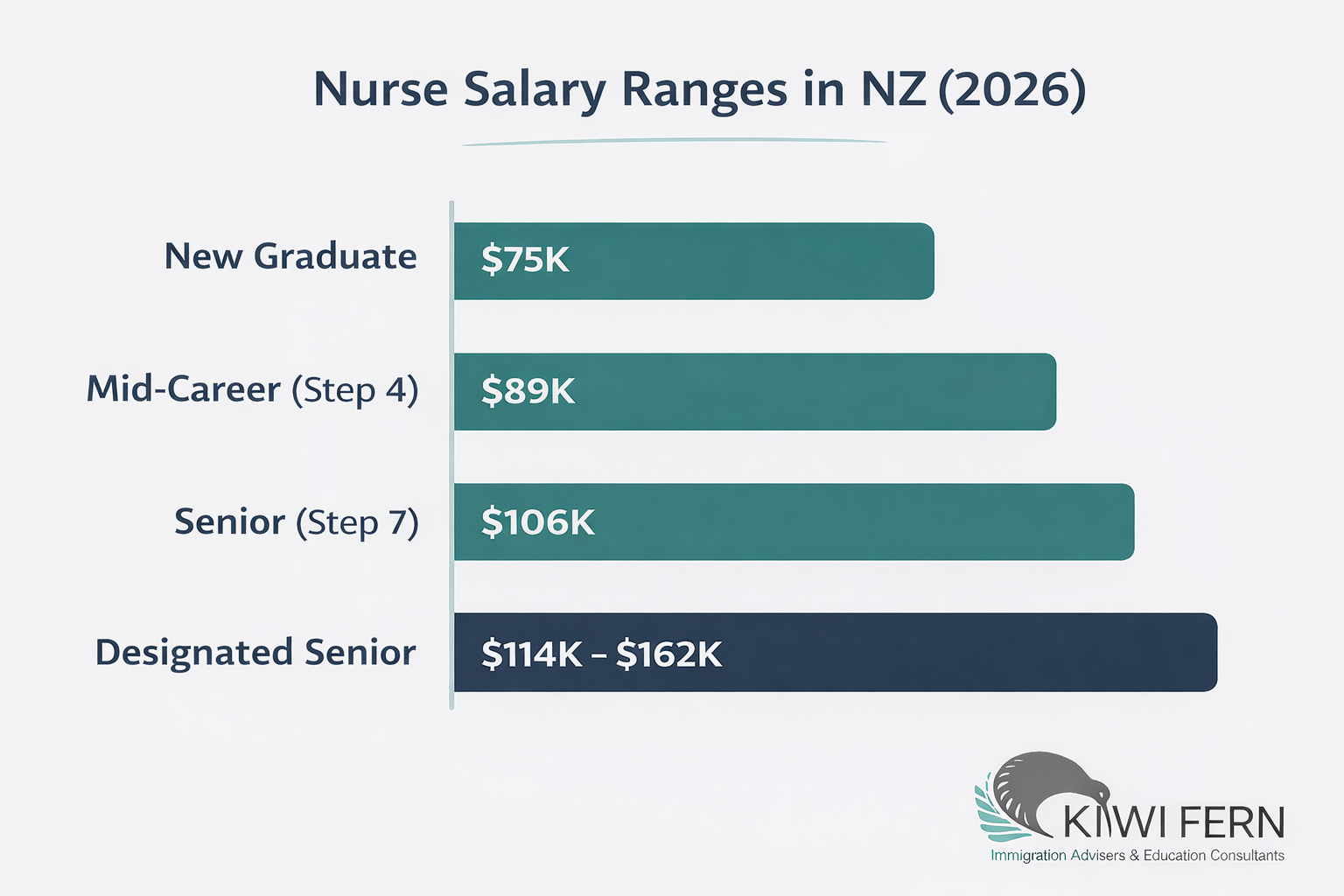
| Experience Level | Annual Salary (NZD) | Hourly Rate (NZD) |
|---|---|---|
| New graduate / Step 1 | $75,000 - $78,000 | ~$36.06 - $37.50 |
| RN Step 2-3 (1-3 years) | $79,000 - $86,000 | ~$38.00 - $41.35 |
| RN Step 4-5 (3-5 years) | $89,000 - $96,000 | ~$42.79 - $46.15 |
| RN Step 6-7 (6+ years) | $100,000 - $106,000 | ~$48.08 - $50.96 |
| Designated Senior Nurse | $114,000 - $162,000 | ~$54.81 - $77.88 |
Note on penal rates: Nurses working nights, weekends, or public holidays earn additional penal rates on top of their base salary. These can add NZD $5,000–$15,000+ per year to your total earnings depending on your roster pattern.
Public vs Private Sector: What's the Difference?
The MECA covers public hospitals and most DHB-successor services under Health NZ. Private hospitals, aged care facilities, and primary care clinics may pay differently - sometimes higher for specialist roles, sometimes lower in aged care. For immigration purposes, both public and private employers can hold INZ accreditation.
Registered Nurse Salary by Region
Like teachers, nurse salaries in the public system are set by a national collective agreement. Your base pay is the same whether you work in Auckland or Invercargill. But your real take-home depends on where you live.
| Region | Average Salary (NZD) | Cost of Living Pressure | Net Verdict |
|---|---|---|---|
| Auckland | $75,000 - $106,000 | Very High (rent: ~NZD $2,600/mo 1BR) | Good salary; budget carefully |
| Wellington | $75,000 - $106,000 | High (rent: ~NZD $2,000/mo 1BR) | Better value than Auckland |
| Christchurch | $75,000 - $106,000 | Medium | Strong purchasing power |
| Hamilton / Waikato | $75,000 - $106,000 | Medium-Low | Excellent purchasing power |
| Regional NZ (e.g. Invercargill, Gisborne) | $75,000 - $106,000 | Low | Best savings potential; staffing incentives possible |
The Auckland reality check: A mid-career RN on Step 4 earning NZD $89,000 takes home roughly NZD $5,900/month after tax. With rent at NZD $2,600 for a one-bedroom flat and living costs of NZD $1,500–$2,000, you're looking at NZD $1,300–$1,800 in monthly savings. Move to Hamilton or Christchurch and that savings margin doubles.
What Factors Affect Your Nurse Salary in NZ?
- MECA step (years of experience): the single biggest factor. You advance one step per year of qualifying service. Your overseas nursing experience may count toward a higher starting step - confirm this with your employer before signing.
- Employer type: public (Health NZ) vs private hospital vs aged care vs primary care. Public system pays under the MECA; private employers set their own rates.
- Specialisation: ICU, emergency, theatre, neonatal, and mental health nurses are in high demand and may attract additional allowances or faster recruitment.
- Shift patterns: night shifts, weekends, and public holidays attract penal rates (time-and-a-quarter to double time) that significantly boost total earnings.
- Location: some rural and hard-to-staff areas offer recruitment incentives, relocation packages, or bonuses.
- Registration level: fully registered nurses earn more than those on provisional or subject-to-conditions registration.
Is Nursing on the NZ Green List? Yes - Tier 1
Yes - and this is the most important thing for overseas nurses to know.
Registered nurses are on New Zealand's Green List under Tier 1 (Straight to Residence). This is the highest tier - better than Tier 2, which requires a two-year work period first.
Here's what Tier 1 means for you:
- You may be eligible to apply directly for permanent residency - without first holding a work visa for two years
- You need a job offer that meets the salary threshold and NCNZ registration
- No Skilled Migrant Category points test required
- Your partner can get an open work visa; your children can attend school as domestic students
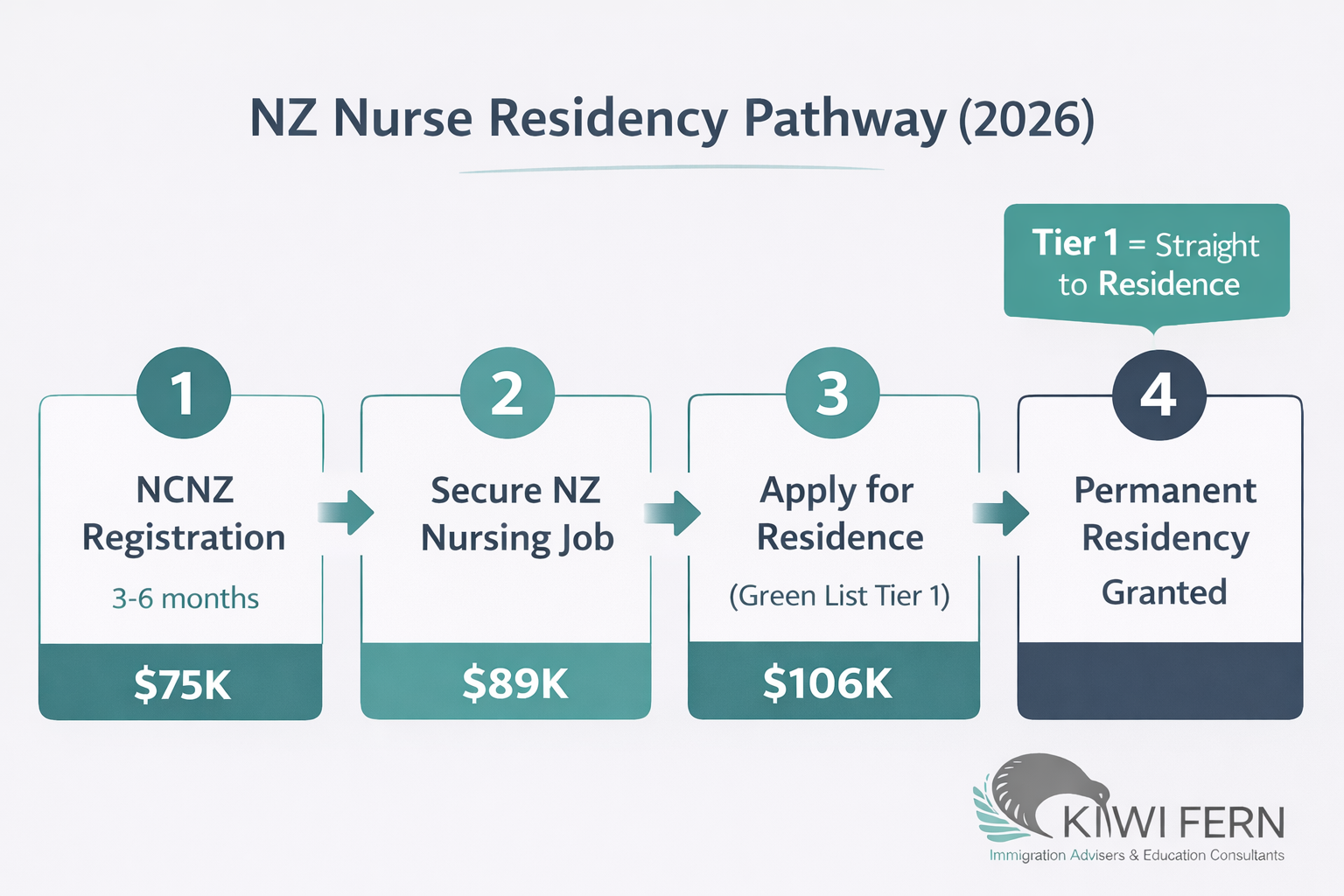
The pathway for registered nurses:
- Register with the Nursing Council of New Zealand (NCNZ) - see requirements below
- Secure a job offer from an INZ-accredited NZ employer (hospital, clinic, aged care)
- Apply for residence under the Green List Tier 1 pathway
- Receive New Zealand permanent residency
immigration.govt.nz - NZ Green List
Nurse Salary in NZ vs Your Home Country
The comparison is dramatic - especially if you're coming from South or Southeast Asia.
| Country | Typical Annual Salary | Approx. NZD Equivalent | NZ Multiple |
|---|---|---|---|
| New Zealand | NZD $75,000-$106,000 | NZD $75,000-$106,000 | Baseline |
| Australia | AUD $75,000-$100,000 | NZD $82,000-$110,000 | ~1.0-1.1x |
| United Kingdom | GBP 28,000-40,000 | NZD $59,000-$84,000 | NZ pays slightly more |
| India | INR 2,50,000-5,00,000 | NZD $4,500-$9,000 | NZ pays 10-20x more |
| Philippines | PHP 180,000-350,000 | NZD $4,700-$9,100 | NZ pays 10-20x more |
| South Africa | ZAR R180,000-R350,000 | NZD $14,500-$28,000 | NZ pays 3-7x more |
Note: Exchange rates fluctuate. Figures are approximate for 2026. Always verify at current exchange rates before financial planning.
For nurses from India, the Philippines, or South Africa, a move to NZ represents a life-changing income increase. Even after accounting for NZ's higher living costs, most overseas nurses save more in a single year than they would in several years at home - while building toward permanent residency.
What You Need to Work as a Nurse in New Zealand
Nursing Council of New Zealand (NCNZ) Registration
You cannot practise as a nurse in New Zealand without registration from the Nursing Council of New Zealand (NCNZ). This applies to all nursing roles - hospital, community, aged care, and private.
Registration process for internationally qualified nurses:
- CGFNS verification: NCNZ requires your identity and documents to be verified through CGFNS (Commission on Graduates of Foreign Nursing Schools) before you can apply. This is a mandatory first step.
- Submit your application to NCNZ: you'll need:
- Nursing qualification transcripts (verified by CGFNS)
- Current nursing registration or licence from your home country
- Evidence of at least 2,500 hours of nursing practice in the last 5 years
- Police clearance certificates (from all countries you've lived in for 12+ months)
- English language proficiency - OET (minimum B in all components) or IELTS Academic (minimum 7.0 overall, no band below 7.0)
- Competence assessment - NCNZ assesses your qualifications against NZ standards. Some nurses may need to complete a Competence Assessment Programme (CAP)
- Registration granted - processing typically takes 3-6 months for straightforward applications
Which Countries' Nursing Qualifications Are Recognised?
NCNZ assesses each application individually. In general:
- UK, Australian, and Irish nursing qualifications: well recognised and typically straightforward
- Indian nursing qualifications (B.Sc Nursing, GNM): assessed case by case. B.Sc Nursing graduates from recognised universities generally have a smoother path
- Filipino nursing qualifications (BSN): assessed case by case. Many Filipino nurses successfully register, but some may need to complete a CAP
- South African nursing qualifications: generally well recognised
If you're unsure whether your qualification meets NCNZ standards, Kiwi Fern's advisers can help you understand your options before you invest in the formal registration process.
How Your Nurse Salary Affects Your NZ Visa
Because nursing is on the Green List Tier 1, the standard AEWV median wage threshold is less relevant - you're applying for residence, not just a work visa. However, your salary still matters:
- Green List salary threshold: Your job offer must meet the minimum salary requirement set by Immigration NZ for your ANZSCO code. For registered nurses, this is comfortably met by any MECA-rate position.
- AEWV median wage threshold (if applying for work visa instead): NZD $29.66/hour (~NZD $61,700/year) as of April 2026. Even a new graduate nurse at NZD $75,000/year ($36/hour) clears this easily.
See the full NZ Work Visa (AEWV) requirements for what your employer needs to do to become accredited.
Frequently Asked Questions
What is the average registered nurse salary in New Zealand in 2026?
The base salary range for a registered nurse in New Zealand is NZD $75,000 to $106,000 per year, set by the NZNO/Health NZ MECA. New graduates start at approximately NZD $75,000 (Step 1), and experienced nurses reach NZD $106,000+ at Step 7.
Is nursing on the NZ Green List?
Yes. Registered nurses are on the NZ Green List under Tier 1 (Straight to Residence), the highest tier. This means you may apply directly for NZ permanent residency with a qualifying job offer, without needing to hold a work visa first.
Can overseas nurses work in New Zealand?
Yes, but you must first register with the Nursing Council of New Zealand (NCNZ). This requires CGFNS verification, proof of qualifications, nursing practice hours, police clearances, and English proficiency (OET or IELTS). Processing takes approximately 3-6 months.
Do nurses earn more in Auckland than other NZ cities?
Base salaries are the same across all regions under the MECA. However, Seek data (April 2026) shows average advertised salaries slightly higher in some centres due to role mix and seniority levels. The real difference is cost of living - a nurse in Christchurch or Hamilton has significantly more disposable income than one in Auckland on the same base salary.
What English test do I need to register as a nurse in NZ?
NCNZ accepts OET with a minimum of B in all four components, or IELTS Academic with a minimum 7.0 overall (no band below 7.0). Some exemptions apply if you trained or practised in a recognised English-speaking country.
Do I need a job offer to get NZ residency as a nurse?
Yes. Even under the Green List Tier 1 pathway, you need a job offer from an INZ-accredited employer. The advantage of Tier 1 is that you can apply directly for residence rather than waiting two years on a work visa first..
What tax will I pay on a nurse salary in NZ?
New Zealand uses progressive income tax (PAYE). On NZD $90,000, expect to pay approximately NZD $18,500-$20,000 in tax, leaving roughly NZD $5,800-$6,000/month take-home. Penal rates for night and weekend shifts are taxed at your marginal rate. Use the IRD calculator at ird.govt.nz for an exact figure.
Are you a nurse thinking about New Zealand?
Kiwi Fern's licensed immigration advisers have helped nurses from India, the Philippines, South Africa, the UK, and beyond navigate NCNZ registration and the Green List Tier 1 residence pathway - as part of one end-to-end service.
Book a Free 15-Minute Call
Vivek is a Licensed Immigration Adviser (IAA Licence No: 202000727) specialising in New Zealand migration pathways.
With personal migration experience and 15+ years across global education and technology sectors, he helps individuals navigate study, work, and residency options with clarity.