

Teacher Salary NZ (2026): What Primary School Teachers Earn
The median salary for a primary school teacher in New Zealand is approximately NZD $70,000-$80,000 per year (roughly NZD $33-$38/hour) as of 2026. Entry-level teachers start at around NZD $57,000, while senior and experienced teachers can earn NZD $90,000 or more.
Teaching is on the NZ Green List (Tier 2) Green List, which means registered teachers can apply for a work visa that leads directly to New Zealand permanent residency after 2 years.
One of the first questions overseas teachers ask is: "Will my NZ teaching salary actually cover my living costs and is it worth the move?"
The answer is yes, but the full picture matters. New Zealand has a national pay scale for teachers set by a collective agreement, so your salary is more predictable than in many other countries. And thanks to the NZ Green List, a teaching job here is also a direct path to permanent residency.
Here's the complete salary breakdown for 2026.
Primary School Teacher Salary Ranges in NZ (2026)
New Zealand primary school teachers are paid under the Primary Teachers' Collective Agreement (PTCA), negotiated between the New Zealand Educational Institute (NZEI) and the Ministry of Education. This means salaries are set on a national scale, not negotiated employer by employer.
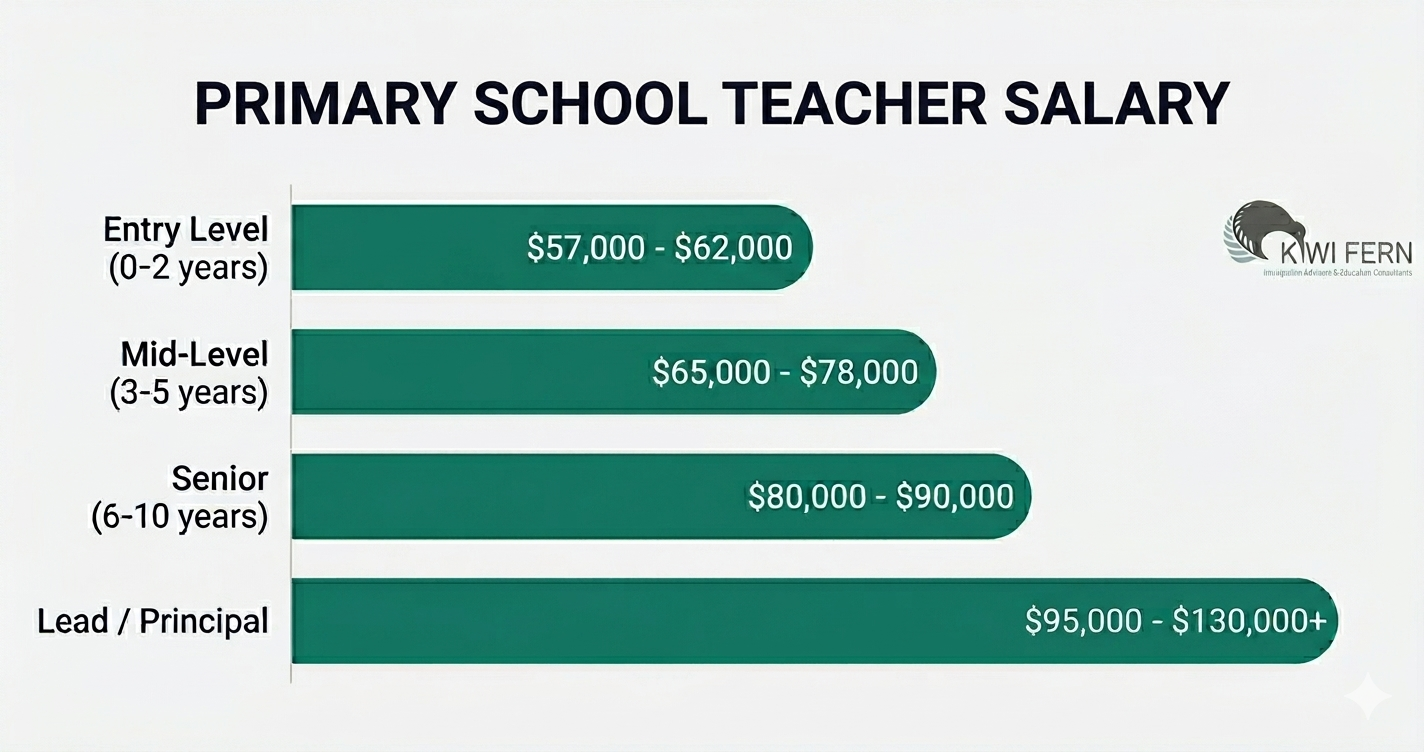
| Experience Level | Annual Salary (NZD) | Hourly Rate (NZD) |
|---|---|---|
| Beginning teacher (0-2 years) | $57,000 - $62,000 | ~$27.40 - $29.80 |
| Classroom teacher (3-5 years) | $65,000 - $78,000 | ~$31.25 - $37.50 |
| Experienced teacher (6-10 years) | $80,000 - $90,000 | ~$38.46 - $43.27 |
| Lead / Senior teacher | $90,000 - $100,000+ | ~$43.27 - $48.08+ |
| Primary school principal | $95,000 - $130,000+ | ~$45.67 - $62.50+ |
Source: PTCA / NZEI
Note on collective pay steps: The PTCA sets salary steps based on years of service. In practice, teachers move up a step each year until they reach the top of the scale. Some allowances apply for roles with extra responsibilities (e.g. Deputy Principal, Head of Department).
Public School vs Private School: Is There a Difference?
Most NZ primary schools are state-funded and follow the PTCA. Private and integrated schools may offer different pay scales, sometimes slightly above the collective rate to attract staff. For immigration purposes, both state and private schools can be INZ-accredited employers.
Primary School Teacher Salary by Region
Here's where NZ teaching differs from most professions: salaries are largely the same across all regions because the national collective agreement applies whether you're in Auckland or a small regional town.
| Region | Average Annual Salary (NZD) | Cost of Living Pressure | Net Verdict |
|---|---|---|---|
| Auckland | $70,000 - $90,000 | Very High (rent: ~NZD $2,600/mo 1BR) | Salary is good; budget carefully |
| Wellington | $70,000 - $90,000 | High (rent: ~NZD $2,000/mo 1BR) | Better value than Auckland |
| Christchurch | $68,000 - $88,000 | Medium | Strong purchasing power |
| Hamilton / Waikato | $65,000 - $85,000 | Medium-Low | Excellent purchasing power |
| Regional NZ (e.g. Gisborne, Napier) | $60,000 - $82,000 | Low | Best savings potential |
Sources: PTCA
The Auckland reality check: A mid-career teacher earning NZD $78,000 in Auckland takes home roughly NZD $5,600/month after tax. With rent at NZD $2,600 for a one-bedroom flat, and groceries/transport at NZD $1,500-$2,000, you're left with NZD $1,000-$1,500 in monthly savings. In Christchurch or Hamilton, the same salary goes considerably further.
What Factors Affect Your Teacher Salary in NZ?
- Years of experience: the PTCA pay scale advances by one step each year of service. Your overseas teaching experience can count toward pay steps, confirm this in writing with your employer before signing.
- School type: state vs. private vs. integrated schools have different (though similar) pay scales
- Additional responsibilities: Deputy Principal, Assistant Principal, or team leader roles attract allowances (NZD $5,000-$20,000+/year on top of base salary)
- Location: some rural schools in hard-to-staff areas offer staffing incentives or higher pay bands
- Registration status: a fully registered teacher (vs. provisional) commands a higher starting step
- Subject specialisation: STEM or ESOL/bilingual teachers are in particularly high demand and may negotiate better terms in private settings
Is Teaching on the NZ Green List?
Registered primary and secondary school teachers are on New Zealand's Green List under Tier 1 (Straight to Residence) and Early Childhood teachers are under Tier 2 (Work to Residence).
Here's what it means in practice:
- Registered primary and secondary school teachers who are working for an accredited employer or have a job offer from one and are paid at least NZD $35.00 an hour can apply for a Straight to Residence Visa (if you meet all other visa requirements)
- Early childhood teachers who are working for an accredited employer and are being paid at least NZD $35.00 (at the time of the application) can apply for a Work to Residence visa after 2 years of employment in New Zealand.
NZ Green List
The Green List is updated periodically. Always confirm your specific teaching role and ANZSCO code qualifies before applying.
Teacher Salary in NZ vs Your Home Country
The numbers look very different depending on where you're coming from.
| Country | Typical Annual Salary | Approx. NZD Equivalent | NZ Multiple |
|---|---|---|---|
| New Zealand | NZD $70,000-$80,000 | NZD $70,000-$80,000 | Baseline |
| Australia | AUD $75,000-$95,000 | NZD $82,000-$105,000 | ~1.1-1.3x |
| United Kingdom | GBP 30,000-45,000 | NZD $63,000-$95,000 | Comparable |
| India | INR 3,00,000-6,00,000 | NZD $5,400-$10,800 | NZ pays 7-14x more |
| Philippines | PHP 200,000-400,000 | NZD $5,200-$10,400 | NZ pays 8-15x more |
| South Africa | ZAR R200,000-R350,000 | NZD $16,000-$28,000 | NZ pays 3-5x more |
Note: Exchange rates fluctuate. Figures are approximate for 2026. Always verify at current exchange rates before financial planning.
For teachers from India, the Philippines, or South Africa, the NZ salary represents a transformational income increase. Even after accounting for NZ's higher cost of living, most overseas teachers find they can live well, save meaningfully, and build toward permanent residency.
What You Need to Teach in New Zealand as an Overseas Teacher
Teaching Council of Aotearoa New Zealand Registration
You cannot teach independently in an NZ school without registration from the Teaching Council of Aotearoa New Zealand. This applies to both state and private schools.
Registration process for overseas-qualified teachers:
- Create an account on the Teaching Council's online portal at Teaching Council NZ
- Submit your qualifications for assessment - typically requires:
- Official transcripts of your teaching qualification
- Confirmation of your teaching licence or registration in your home country
- Police clearance certificate (from all countries you've lived in for 12+ months)
- English language evidence (if required)
- Assessment typically takes 3-6 months for overseas applicants
- You may initially receive provisional or provisional with conditions registration, allowing you to teach under a mentor's guidance
- Full registration is granted once all conditions are met
Requirements change. Always verify directly with the Teaching Council before applying.
Does Your Teaching Qualification Qualify?
The Teaching Council assesses overseas qualifications case by case. Generally:
- UK, Australian, South African, and Irish teaching qualifications are well recognised and typically straightforward to assess
- Indian teaching qualifications (B.Ed.) are assessed - outcomes vary by institution and programme
- Filipino teaching qualifications are assessed - some applicants may need additional requirements met
If you're unsure whether your qualification will be accepted, Kiwi Fern's advisers can help you understand your options before you begin the formal process.
Frequently Asked Questions
What is the average primary school teacher salary in New Zealand in 2026?
The average primary school teacher salary in New Zealand is approximately NZD $70,000-$80,000 per year in 2026, based on the Primary Teachers' Collective Agreement (PTCA) pay scales. Entry-level teachers start at around NZD $57,000, and experienced teachers can earn NZD $90,000 or more.
Is teaching on the NZ Green List?
Yes. Registered primary and secondary school teachers are on the NZ Green List under Tier 1 (Straight to Residence) and early childhood teachers are under Tier 2 (Work to Residence).
Can overseas teachers work in New Zealand?
Yes, but you must register with the Teaching Council of Aotearoa New Zealand first. The process takes 3-6 months for overseas applicants.
Do teachers earn more in Auckland than other NZ cities?
Not significantly, teacher salaries in NZ are set by a national collective agreement (the PTCA), so base pay is largely the same across the country.
Do I need a job offer to get an NZ work visa as a teacher?
Yes. Both the AEWV and the Green List Work Visa require a job offer from a New Zealand school accredited with Immigration NZ. Your salary must also meet the NZ median wage threshold.
Are you a teacher thinking about New Zealand?
Kiwi Fern's licensed immigration advisers have helped teachers from India, the Philippines, South Africa, the UK, and beyond navigate Teaching Council registration and their NZ work visa - as part of one end-to-end service.
Book a Free 15-Minute Call
Vivek is a Licensed Immigration Adviser (IAA Licence No: 202000727) specialising in New Zealand migration pathways.
With personal migration experience and 15+ years across global education and technology sectors, he helps individuals navigate study, work, and residency options with clarity.